

Diamond Segments Explained: Types, Bonds and Applications

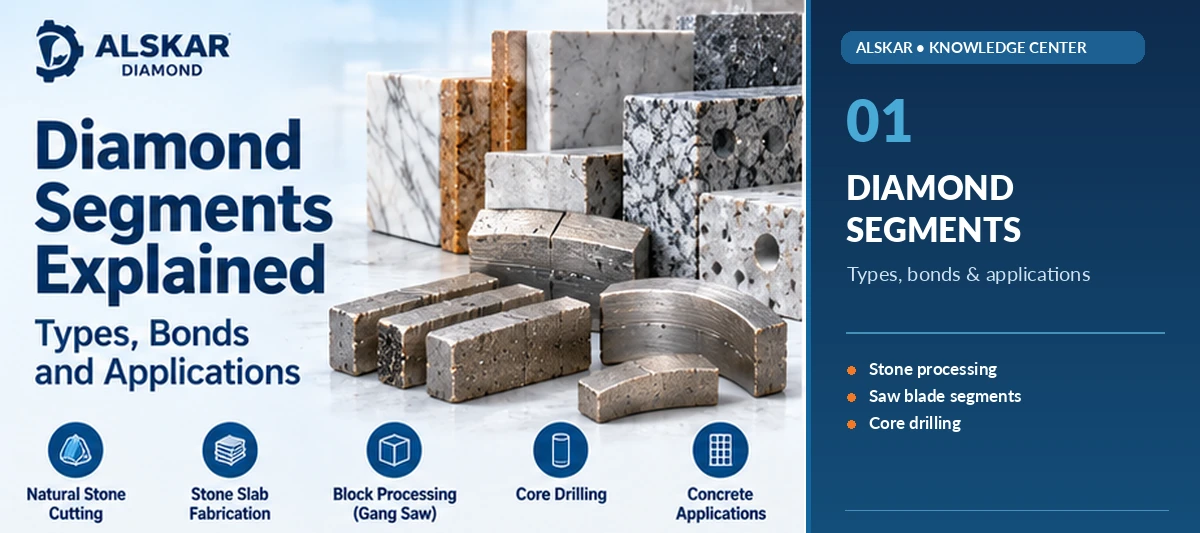
Diamond Segments Explained: Types, Bonds and Applications
A Professional Guide to Diamond Segment Construction, Metal Bond Hardness, Gang Saw Segments, Bridge Saw Segments, and Core Bit Segments
Diamond segments are the cutting components used in many professional diamond saw blades and core drilling tools.
Whether cutting granite blocks, processing marble slabs, fabricating quartzite countertops, or drilling concrete, the performance of a diamond tool depends heavily on the design and formulation of its cutting segments.
However, diamond segments are not interchangeable simply because they have similar dimensions.
Different applications require different diamond specifications, metal bonds, segment geometries, attachment methods, and operating conditions.
For stone fabricators, diamond tool manufacturers, and professional contractors, selecting the correct segment can affect cutting speed, usable tool life, cut quality, machine loading, and total production cost.
In this guide, ALSKAR DIAMOND explains how diamond segments work, the differences between hard and soft metal bonds, the main types of diamond segments, and how to choose the appropriate segment for specific cutting and drilling applications.
1. What Are Diamond Segments?
Diamond segments are engineered cutting elements containing industrial diamond particles distributed within a supporting matrix, commonly made from formulated metal powders.
They form the working cutting surfaces of many segmented diamond saw blades, core drill bits, and stone-processing tools.
Depending on the tool design, segments may be attached to a steel blade core, a gang saw blade, or a cylindrical core drill barrel.
What Is Inside a Diamond Segment?
Three elements are particularly important:
Industrial Diamond Particles
Synthetic industrial diamonds provide the abrasive cutting points that engage the material.
Diamond quality, particle size, concentration, and distribution affect cutting behavior.
Metal Bond Matrix
The metal bond supports the diamond particles and controls how quickly worn diamonds are released and fresh cutting points become exposed.
Segment Geometry
The segment’s length, width, height, shape, and cutting-face configuration influence the cutting contact area, kerf, clearance, wear behavior, and compatibility with the tool body.
The performance of a diamond segment is determined by the interaction of these factors, not by any one specification alone.
2. How Do Diamond Segments Cut Stone and Concrete?
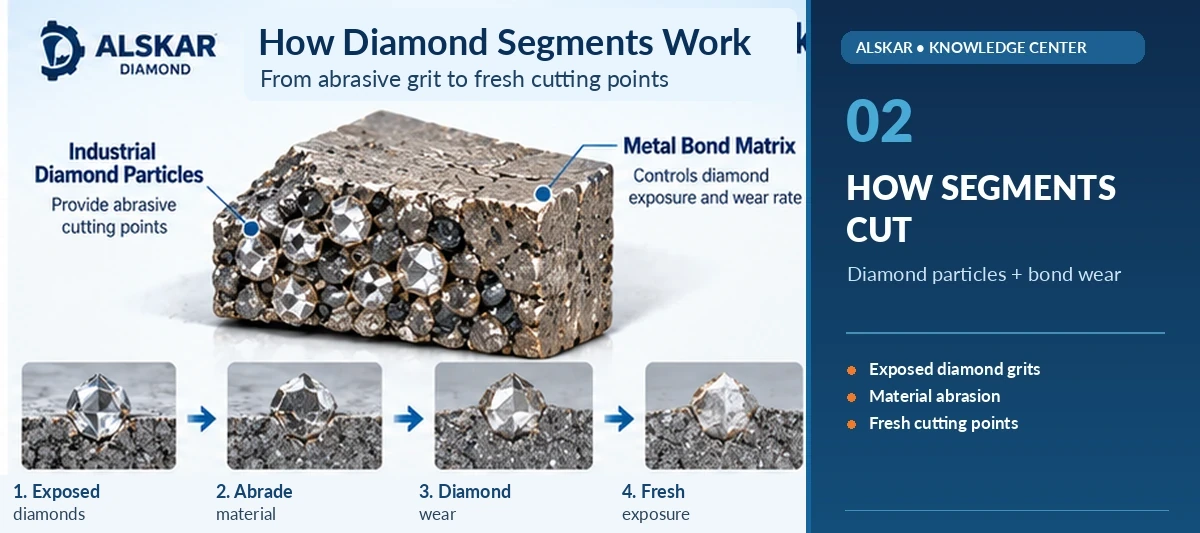
Diamond segments remove hard mineral materials primarily through an abrasive cutting process.
During cutting, exposed diamond particles engage and abrade the workpiece.
As the diamond particles become worn or fractured, controlled erosion of the surrounding metal bond helps expose additional cutting points.
This creates a continuing cycle:
- Exposed diamonds contact the workpiece.
- Diamond particles abrade and remove material.
- Worn diamonds lose cutting effectiveness.
- The metal bond gradually wears.
- New diamond cutting points become exposed.
A properly matched segment maintains this process at a suitable rate.
What Happens When the Bond Wears Too Slowly?
The segment may become polished or glazed.
Cutting speed decreases because sufficient sharp diamond particles are not exposed.
What Happens When the Bond Wears Too Quickly?
The segment may lose diamond particles prematurely.
Cutting may initially feel aggressive, but usable segment life can become unnecessarily short.
The objective is not maximum bond hardness or maximum diamond concentration. It is achieving the correct balance between diamond exposure, cutting performance, and segment wear.
3. Understanding Diamond Bond Hardness
Diamond bond hardness is one of the most important factors in segment selection.
The metal bond is designed to wear at a controlled rate under the expected cutting conditions.
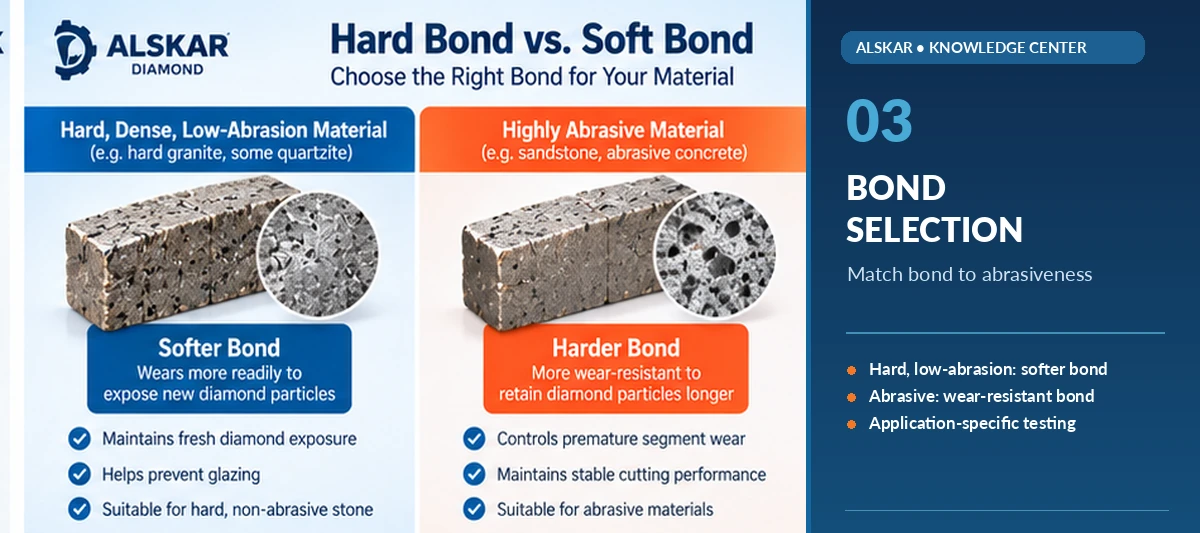
Soft Bond Diamond Segments
A relatively softer bond wears more readily, helping expose new diamond cutting points.
This may be useful when cutting hard, dense, relatively nonabrasive materials where a more wear-resistant bond could become polished.
Hard Bond Diamond Segments
A relatively harder, more wear-resistant bond helps retain diamond particles longer.
This can be beneficial for materials that aggressively wear the segment matrix.
Diamond Bond Selection Table
| Material Behavior | General Bond Direction | Main Objective |
|---|---|---|
| Hard, dense, low-abrasion material | Relatively softer bond | Maintain fresh diamond exposure |
| Moderately abrasive material | Application-matched intermediate bond | Balance cutting and segment wear |
| Highly abrasive material | Relatively harder bond | Control premature segment consumption |
| Material with variable properties | Specialized formulation | Balance performance across changing conditions |
This relationship is a general technical principle.
Actual bond selection also depends on the material’s mineral composition, cutting equipment, cooling, feed rate, segment geometry, and manufacturer-specific formulation.
Important: Hard Material Does Not Always Mean High Abrasiveness
Hardness and abrasiveness are related but different characteristics.
A material can be difficult to penetrate without rapidly wearing the segment matrix.
Another material may be relatively easy to cut but highly abrasive to the bond.
For example, different concrete aggregates and natural stone varieties can produce significantly different cutting conditions.
Choose diamond segments based on hardness, abrasiveness, and actual cutting behavior—not simply the material’s commercial name.
4. Diamond Grit Size, Concentration, and Quality
Metal bond selection is only one part of segment engineering.
The diamond specification must also match the application.
Diamond Particle Size
Coarser diamond particles may be suitable for some aggressive material-removal applications.
Finer diamond particles can be useful in other conditions requiring a different cutting interaction or surface finish.
There is no universal diamond grit size for every granite, marble, or concrete application.
Diamond Concentration
Diamond concentration affects the number of cutting particles available within the bond matrix.
However, higher concentration does not automatically mean faster cutting.
Performance depends on whether the machine can effectively load the cutting points and whether the bond exposes them appropriately.
Diamond Quality and Toughness
Industrial diamonds differ in crystal shape, toughness, thermal stability, and resistance to fracture.
The correct diamond specification depends on expected cutting forces and processing conditions.
Diamond Distribution
Uniform and application-appropriate diamond distribution can influence cutting consistency.
Some specialized segment systems use engineered diamond placement rather than fully random distribution.
For buyers, the complete segment performance specification is more useful than a single statement such as “high diamond concentration.”
5. Main Types of Diamond Segments
Diamond segments can be grouped according to their tool application.
Three major categories relevant to ALSKAR DIAMOND are:
- Gang Saw Diamond Segments
- Bridge Saw Diamond Segments
- Diamond Core Bit Segments
Although all three use industrial diamond cutting elements, their geometry, operating conditions, and attachment requirements differ substantially.
Comparison of Diamond Segment Types
| Segment Type | Tool Application | Primary Purpose | Important Selection Factors |
|---|---|---|---|
| Gang Saw Segments | Multi-blade or reciprocating stone saw systems | Cutting stone blocks into slabs | Blade system, stone type, segment profile, cutting conditions |
| Bridge Saw Segments | Circular stone-cutting blades | Slab cutting, sizing and fabrication | Blade diameter, kerf, stone characteristics, machine setup |
| Core Bit Segments | Cylindrical diamond core bits | Drilling circular holes | Core diameter, segment geometry, material, connection, cooling |
A segment designed for a gang saw is not automatically suitable for a bridge saw or core drill.
Each segment must be matched to the intended tool body and operating system.

6. Gang Saw Diamond Segments
Gang saws are widely used in industrial stone processing to cut large stone blocks into slabs.
Depending on the equipment design, these machines may use multiple cutting blades operating together.
Gang saw segments must be engineered for the machine’s blade configuration, stroke or cutting motion, material characteristics, and operating conditions.
Marble Gang Saw Segments
ALSKAR DIAMOND offers diamond segments for marble gang saw applications.
Marble processing requires attention to cutting efficiency, surface quality, and controlled tool wear.
Different marble varieties can vary in mineral composition, texture, abrasiveness, and cutting response.
The segment formulation should therefore be selected for the actual stone and machine.
Granite Gang Saw Segments
Granite gang saw applications can involve hard mineral constituents and demanding production conditions.
Granite segment selection should consider the actual stone composition, machine configuration, cutting speed, and cooling system.
A formulation selected for one granite variety may not deliver the same performance on another.
Gang Saw Segment Selection Checklist
Before selecting gang saw segments, confirm:
- Stone type and quarry material
- Machine model and blade system
- Blade dimensions and mounting arrangement
- Segment dimensions and cutting-face design
- Cutting speed and feed conditions
- Cooling system
- Expected production requirements
For industrial block processing, customers should evaluate cutting productivity and segment consumption together rather than judging performance only by the purchase price of each segment.
7. Bridge Saw Diamond Segments
Bridge saws are commonly used in stone fabrication to cut slabs into finished sizes and shapes.
The diamond segments operate on circular cutting blades.
Bridge saw applications may include straight cuts, repeated sizing operations, and approved angled cutting methods.
Marble Saw Blade Segments
ALSKAR Marble Saw Blade Segments are intended for suitable marble-cutting applications.
Selection should consider marble variety, required cut quality, blade diameter, segment width, and the machine’s operating conditions.
Avoid assuming that a segment optimized for marble will perform equally well on granite or quartzite.
Granite Saw Blade Segments
Granite saw blade segments must support effective cutting of hard mineral constituents while maintaining suitable segment wear.
The correct diamond and bond specification depends on the granite variety and fabrication process.
Quartzite Bridge Saw Segments
Quartzite is a particularly demanding natural stone for many fabricators.
Its high quartz content and material characteristics can make cutting difficult, especially when edge quality and consistent production are important.
Specialized quartzite segment formulations may be required.
ALSKAR DIAMOND offers a dedicated Quartzite Bridge Saw Segment product family.
The segment should be selected according to the specific quartzite, blade design, cutting method, cooling arrangement, and machine capabilities.
How to Choose the Right Diamond Saw Blade
Why Use Dedicated Stone Segments?
A general-purpose segment may cut several stone types, but a specialized formulation can provide a better match for a particular production environment.
For professional fabricators, the final selection should consider:
- Cutting rate
- Edge quality
- Segment wear
- Machine load
- Blade stability
- Repeatability of the cutting process
Not every segment is suitable for all natural or engineered stone products.
8. Diamond Core Bit Segments
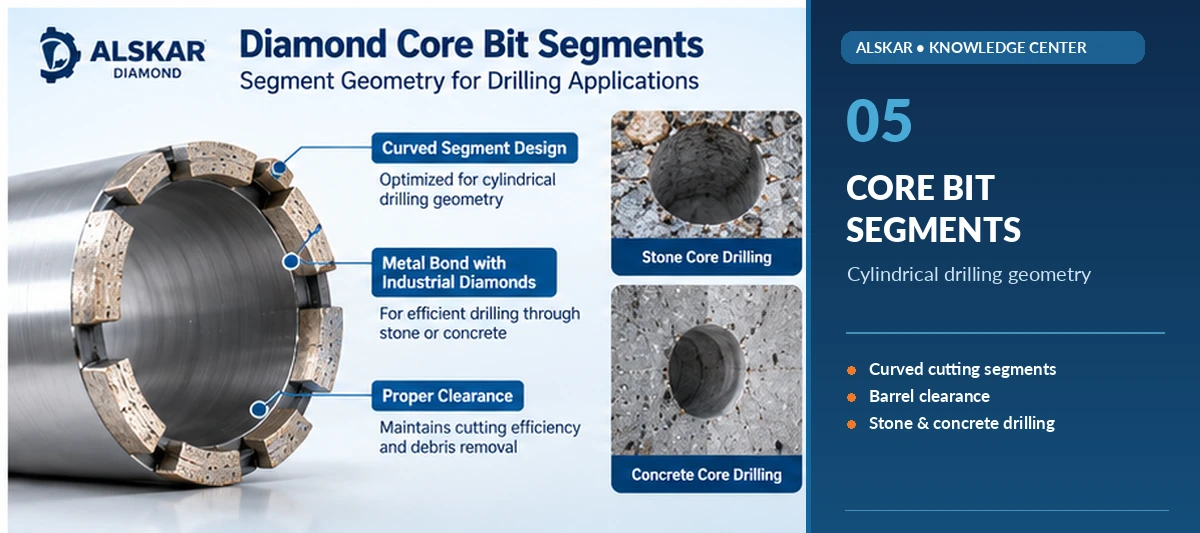
Core bit segments are attached around the cutting end of a cylindrical drill barrel.
Unlike segments used on circular saw blades, they must work within an annular drilling geometry.
The bit removes material around a circular core while the center remains largely intact until the core is separated.
Stone Core Bit Segments
ALSKAR Stone Core Bit Segments are intended for applicable natural stone drilling tools.
The segment specification must match the target stone, core bit diameter, barrel geometry, drilling machine, and operating method.
Concrete Core Bit Segments
ALSKAR Concrete Core Bit Segments are designed for appropriate concrete drilling tool applications.
Concrete core drilling may involve hard aggregates and, where explicitly permitted by the bit specification and project requirements, reinforcement.
Segment performance depends on the bond, diamond properties, geometry, cooling, and drill motor settings.
Why Core Bit Segment Geometry Matters
A core bit requires enough cutting clearance for its barrel while maintaining the structural support necessary for drilling.
Segment width, circumferential spacing, and the complete cutting-head design affect the drilling process.
Segments should not be selected for replacement or re-tipping solely by matching the nominal core bit diameter.
Wet vs. Dry Core Drilling
Segment design and attachment must be suitable for the intended operating method.
For example, wet core bits depend on required water delivery for cooling and debris removal.
A dry masonry bit may be designed for specific softer masonry materials.
A segment being laser-welded does not automatically make the completed tool suitable for all dry-drilling or reinforced-concrete applications.
Always follow the rating of the complete core bit.
How to Choose the Right Diamond Core Bit
9. Segment Geometry: Length, Width, and Height
Diamond segment dimensions are important for both cutting performance and compatibility.
Segment Length
Length influences the segment’s available contact area and arrangement on a blade or barrel.
Its effect depends on the tool type and cutting geometry.
Segment Width
Width contributes to the cutting kerf and clearance around the blade core or core drill barrel.
An incorrect segment width can result in rubbing, binding, or unsuitable cutting geometry.
Segment Height
Segment height can influence the usable volume of the cutting element.
However, a taller segment is not automatically a longer-lasting segment.
Actual life depends on diamond-bearing depth, bond formulation, cutting conditions, and permitted wear limits.
Segment Shape
Segments may use straight, shaped, or other application-specific profiles.
Different geometries can influence initial cutting behavior, material clearance, and contact characteristics.
Technical Specification Checklist
| Specification | Information to Confirm |
|---|---|
| Segment length | Exact length in mm |
| Segment width | Exact kerf/clearance requirement |
| Segment height | Overall and usable diamond-bearing height |
| Segment profile | Drawing or approved cutting geometry |
| Material | Actual stone or concrete specification |
| Bond formulation | Application-matched grade |
| Tool body | Blade or barrel compatibility |
| Attachment method | Approved joining process |
| Operating conditions | Speed, feed, cooling and loading |
When ordering replacement segments, provide a technical drawing or confirmed existing segment reference whenever possible.
10. How Are Diamond Segments Attached?
The attachment method is a critical part of the complete cutting tool.
Different products may use laser welding, brazing, or other manufacturer-specified joining methods.
Laser Welding
Laser welding joins the segment assembly to the intended steel body using a controlled welding process.
It is used in various professional diamond saw blade and core bit designs.
Brazing
Brazing uses a suitable filler material and controlled joining process to attach segments to a tool body.
Correct joint preparation, materials, temperature control, and quality checks are essential.
Sintering
Sintering describes a manufacturing process in which powders are consolidated under heat and, depending on the process, pressure.
Some complete tool constructions integrate sintered cutting sections with a supporting core.
Manufacturing a sintered segment is not the same as specifying how that finished segment is attached to the tool body.
Can Diamond Segments Be Replaced?
Some industrial blades and core barrels are designed to be re-tipped by qualified specialists.
However, not every tool is suitable for segment replacement.
Re-tipping requires verification of the body condition, segment geometry, joining method, and inspection criteria.
Do not attempt unapproved segment attachment or operate tools with damaged or missing segments.
11. Common Diamond Segment Problems
When cutting performance decreases, the segment specification is only one potential cause.
Machine setup, material variation, cooling, blade condition, and operating parameters can also contribute.
Common Problems and Possible Causes
| Problem | Possible Causes | Recommended Check |
|---|---|---|
| Slow cutting | Glazed segments, unsuitable bond, low power | Verify material, bond and equipment |
| Excessive segment wear | Highly abrasive material, unsuitable bond | Check wear pattern and formulation |
| Uneven segment wear | Misalignment, unstable tool body, improper feed | Inspect machine and blade condition |
| Excessive chipping | Unsuitable cutting conditions or tooling | Check stone support, tool and feed |
| Segment overheating | Inadequate cooling or excessive friction | Inspect water system and loading |
| Segment loss | Joint failure, damage, overheating or impact | Stop immediately; professionally evaluate tool |
| Tool body rubbing | Incorrect segment clearance or wear | Check segment width and tool body |
| Repeated glazing | Bond too wear-resistant for conditions | Review specification with supplier |
Why Segments Become Glazed
Glazing often occurs when the bond does not wear sufficiently to expose fresh diamond cutting points.
Appropriate corrective action depends on the tool and manufacturer instructions.
A manufacturer-approved dressing procedure may help if the segment is otherwise sound.
Repeated glazing suggests a possible mismatch between segment formulation and cutting conditions.
Why Do Diamond Core Bits Stop Drilling?
Why Segments Wear Too Quickly
High material abrasiveness, an unsuitable bond, incorrect cutting conditions, or machine problems can accelerate segment consumption.
A different bond formulation may be needed.
What If a Segment Becomes Detached?
Stop using the tool immediately.
A blade or core bit with a missing segment can be hazardous.
Do not continue cutting or attempt an improvised repair.
Have the tool inspected and repaired or replaced according to the manufacturer’s procedures.
12. ALSKAR DIAMOND Segment Product Families
ALSKAR DIAMOND offers a dedicated range of diamond segment products for stone cutting and concrete drilling tool applications.
Our seven product families are organized by tool type and target material.
ALSKAR Diamond Segments Product Overview
| ALSKAR Product Family | Tool Application | Target Material |
|---|---|---|
| Marble Gang Saw Segments | Gang saw blades | Marble |
| Granite Gang Saw Segments | Gang saw blades | Granite |
| Stone Core Bit Segments | Stone core drill bits | Applicable natural stone |
| Concrete Core Bit Segments | Concrete core drill bits | Concrete |
| Quartzite Bridge Saw Segments | Bridge saw blades | Quartzite |
| Marble Saw Blade Segments | Circular stone-cutting blades | Marble |
| Granite Saw Blade Segments | Circular stone-cutting blades | Granite |

Each family serves a different cutting or drilling application.
For accurate product selection, buyers should review the specific segment’s dimensions, formulation, target materials, and machine requirements.
Different product families should not be treated as mechanically interchangeable.
Product Selection by Application
Marble Block Processing: Evaluate Marble Gang Saw Segments.
Granite Block Processing: Evaluate Granite Gang Saw Segments.
Stone Core Drilling: Evaluate Stone Core Bit Segments.
Concrete Core Drilling: Evaluate Concrete Core Bit Segments.
Quartzite Slab Fabrication: Evaluate Quartzite Bridge Saw Segments.
Marble Circular Saw Cutting: Evaluate Marble Saw Blade Segments.
Granite Circular Saw Cutting: Evaluate Granite Saw Blade Segments.
The product name indicates the intended application category, while final compatibility depends on the complete technical specification.
13. How to Request the Correct Diamond Segment Specification
For professional diamond segment purchasing, providing complete application details helps prevent specification errors.
Information to Include in Your Inquiry
1. Segment Type
Gang saw, bridge saw, circular saw blade, or core bit segment.
2. Material
Marble, granite, quartzite, concrete, or another specific material.
3. Segment Dimensions
Required length × width × height, preferably in millimeters.
4. Blade or Core Bit Details
Tool diameter, blade/body configuration, barrel dimensions, and other relevant technical information.
5. Machine Information
Machine manufacturer, model, and applicable operating conditions.
6. Cutting Method
Wet or dry operation, where applicable and approved.
7. Bond or Performance Requirement
Describe material hardness, abrasiveness, desired cutting rate, and any observed problems.
8. Quantity and Destination
Estimated order quantity and delivery country.
9. Existing Product Reference
Provide an existing segment drawing, sample specification, or product photograph when available.
Why a Test Application May Be Necessary
Natural stone can vary considerably even within the same named commercial variety.
For demanding applications, controlled testing may be helpful to validate cutting speed, segment wear, and finished edge quality before larger orders.
14. Stone Cutting Safety and Dust Control
Diamond segment selection must be considered together with safe equipment operation.
Cutting natural stone, quartzite, granite, concrete, and certain engineered stone materials can generate respirable crystalline silica.
Suitable exposure controls are essential.
In the United States, applicable OSHA silica requirements depend on whether the task is covered under construction or general industry rules.
Water delivery, local exhaust ventilation, equipment enclosure, work practices, exposure assessment, and respiratory protection may be required depending on the operation.
Using water does not automatically prove that exposures are adequately controlled.
Essential Safety Practices
- Use only approved blade or core bit assemblies.
- Confirm rated speed and operating compatibility.
- Inspect segment attachment and tool condition.
- Stop immediately if segments are cracked or missing.
- Use specified cooling and dust-control measures.
- Secure the stone or workpiece correctly.
- Follow the equipment manufacturer’s instructions.
- Manage slurry and cutting waste safely.
- Allow only qualified personnel to perform segment re-tipping.
Never operate a damaged or improperly assembled diamond cutting tool.
15. Final Diamond Segment Selection Checklist
Before choosing diamond segments, confirm the following:
- What material will be cut or drilled?
- How hard and abrasive is the material?
- Is the application gang sawing, bridge sawing, or core drilling?
- What are the exact segment dimensions?
- Which diamond and bond specification is appropriate?
- What is the required tool body and attachment method?
- What equipment and operating conditions will be used?
- Is the cooling or dust-control setup suitable?
- What cutting speed, finish, and service life are required?
- Has compatibility been verified before production?
Final Recommendation
Diamond segments should be selected as engineered cutting components rather than generic replacement parts.
The correct balance of industrial diamond properties, metal bond hardness, segment geometry, and machine compatibility determines effective performance.
For professional stone fabrication and concrete drilling, application-matched diamond segments can help achieve more consistent cutting, controlled wear, and reliable production results.
Frequently Asked Questions
What are diamond segments made of?
Diamond segments commonly contain synthetic industrial diamond particles embedded within an engineered metal bond matrix.
How do diamond segments cut stone?
Exposed diamond particles abrade the material. Controlled wear of the metal bond helps release worn diamonds and expose fresh cutting points.
What is the difference between hard bond and soft bond diamond segments?
Hard bonds resist wear more strongly, while softer bonds wear more readily. Bond selection depends on material hardness, abrasiveness, diamond specification, and cutting conditions.
Which diamond segments are suitable for granite?
Granite segments must be selected for the specific stone and cutting system. ALSKAR offers granite gang saw segments and granite saw blade segments for their respective applications.
Do quartzite cutting tools need special diamond segments?
Many quartzite materials are demanding to cut. Specialized diamond and bond formulations may improve suitability for specific stones and fabrication conditions.
What is the difference between gang saw and bridge saw segments?
Gang saw segments are designed for gang saw blade systems used in block processing. Bridge saw segments are designed for circular blades used in slab fabrication.
Can bridge saw segments be used on core drill bits?
Not without specific engineering approval. Core bit segments require geometry and compatibility appropriate to cylindrical drilling barrels.
Are taller diamond segments always better?
No. Usable cutting life depends on diamond-bearing depth, bond formulation, material characteristics, operating conditions, and allowable wear.
Why do diamond segments become polished or glazed?
Glazing may occur when the bond does not wear sufficiently to expose new cutting points. It can indicate unsuitable cutting conditions or an application mismatch.
Can diamond segments be replaced on an old saw blade?
Some industrial blades can be re-tipped by qualified specialists after inspection. Not all blade bodies are suitable for segment replacement.
Can laser-welded diamond segments be used for dry cutting?
Laser welding alone does not establish dry-cutting suitability. Follow the complete blade or core bit manufacturer’s operating instructions.
How do I request custom diamond segments from ALSKAR?
Provide your segment type, dimensions, material, tool body, machine model, performance requirements, order quantity, and delivery destination.
Explore ALSKAR DIAMOND Diamond Segments
ALSKAR DIAMOND provides diamond segment solutions for professional stone fabrication and concrete drilling applications.
Explore our Marble and Granite Gang Saw Segments, Stone and Concrete Core Bit Segments, Quartzite Bridge Saw Segments, and Marble and Granite Saw Blade Segments.
For technical selection assistance or bulk inquiries, submit your material, segment dimensions, machine requirements, estimated quantity, and available technical drawings through the ALSKAR DIAMOND Request a Quote form.
Technical note: This guide provides general information about diamond segment technology and selection. All actual tool specifications, joining procedures, operating ratings, and material compatibility must be verified against the relevant product documentation and equipment instructions.
Request a Quote for Diamond Segments
Looking for diamond segments for marble, granite, quartzite, or concrete applications?
ALSKAR DIAMOND provides dedicated segment product families for gang saw blades, circular stone saw blades, bridge saw blades, and diamond core drill bits.
Share your segment type, dimensions, cutting material, machine requirements, estimated quantity, and delivery destination.
Request a Quote for Diamond Segments