Wet Cutting vs. Dry Cutting: Which Is Better for Diamond Blades?

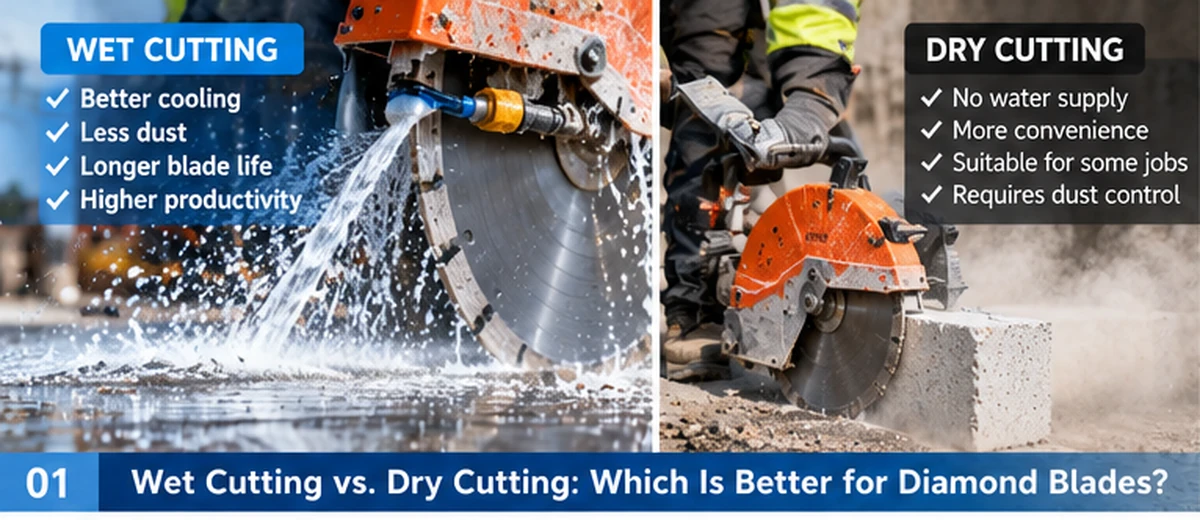
Wet Cutting vs. Dry Cutting: Which Is Better for Diamond Blades?
A Professional Guide to Blade Cooling, Cutting Performance, Dust Control, and Safe Saw Operation
Should you use water when cutting concrete with a diamond blade, or is dry cutting a better option?
The answer depends on the diamond blade, saw specifications, material, cutting conditions, and applicable workplace safety requirements.
Wet cutting is widely used in professional concrete and masonry applications because water helps control heat, carry away cutting debris, and suppress airborne dust.
Dry cutting can offer practical advantages in certain applications, particularly when water delivery is impractical and both the blade and equipment are specifically designed for dry operation.
However, dry cutting is not simply wet cutting without water.
The two methods place different thermal and operational demands on diamond blades.
In this guide, ALSKAR DIAMOND explains how wet and dry diamond cutting compare, when each method may be appropriate, and what contractors should check before selecting a blade.
1. What Is Wet Diamond Cutting?
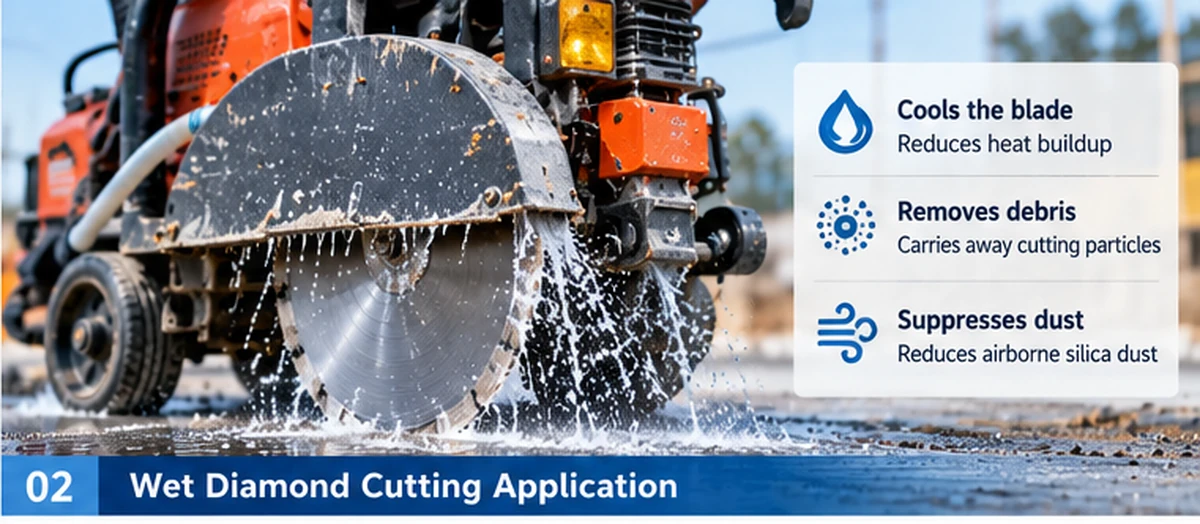
Wet cutting uses a controlled supply of water delivered to the blade and cutting area during operation.
The water performs several important functions.
Blade Cooling
Friction and cutting resistance generate heat at the blade’s cutting edge.
Water helps remove heat from the blade and cutting interface, reducing the risk of excessive thermal buildup.
This is particularly important during demanding or extended cutting operations.
Cutting Debris Removal
Water helps carry away loosened concrete, stone, and other cutting particles.
Removing debris from the cutting zone can improve cutting consistency and reduce unnecessary friction.
Dust Suppression
Cutting concrete, brick, and other silica-containing materials can generate respirable crystalline silica.
Properly designed water-delivery systems can substantially reduce airborne dust emissions.
However, wet cutting does not automatically eliminate silica exposure or guarantee compliance with workplace safety regulations.
Common Wet-Cutting Applications
Wet cutting is frequently used for:
- Professional walk-behind concrete sawing
- Asphalt and pavement cutting with water-compatible equipment
- Reinforced concrete cutting with approved blades
- Stationary masonry saw applications
- High-production cutting operations
- Applications requiring wet-only diamond blades
The blade and saw must both be approved for wet operation.
2. What Is Dry Diamond Cutting?
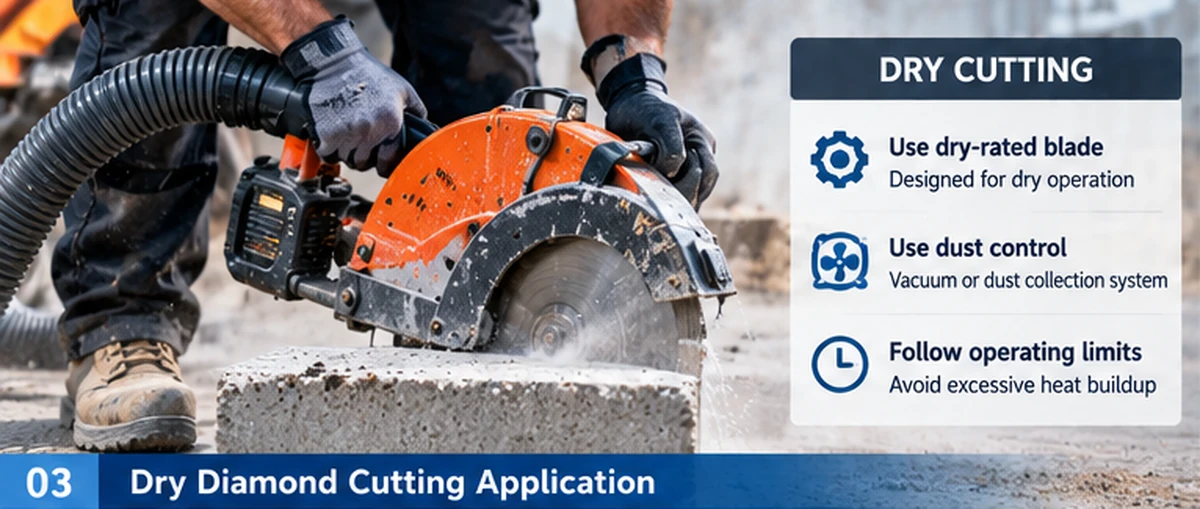
Dry cutting uses a diamond blade specifically rated for operation without continuous water cooling.
Dry-rated blades are engineered for their intended thermal conditions, cutting materials, and equipment.
Some dry-cutting applications rely on limited or intermittent cutting cycles to reduce heat buildup. The correct procedure depends on the blade and saw manufacturer’s instructions.
A dry-rated blade does not automatically permit continuous, unrestricted cutting.
Advantages of Dry Cutting
Depending on the application, dry cutting may offer:
- No water supply or hose requirement
- Less wet slurry to collect
- Greater convenience for certain small or temporary jobs
- Practical use where water delivery is restricted
- Reduced setup requirements for compatible equipment
These advantages should be evaluated alongside dust-control requirements and blade operating limits.
Limitations of Dry Cutting
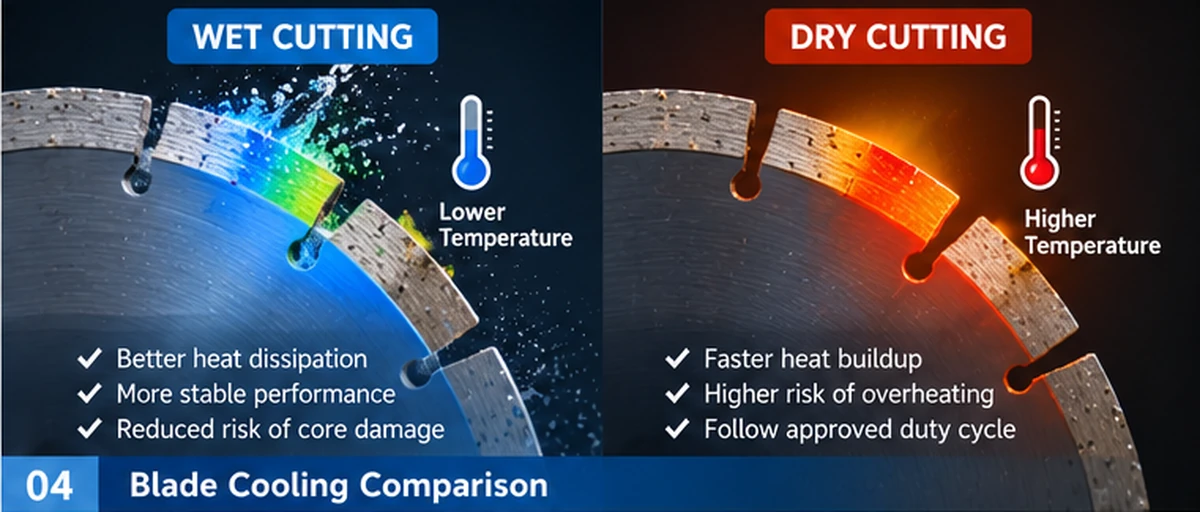
Dry cutting can produce greater thermal stress when compared with an otherwise similar wet-cutting application.
Without appropriate engineering controls, it can also generate significant airborne dust.
Excessive heat may contribute to loss of blade tension, damage to the steel core, or deterioration of the cutting segment attachment.
Never assume a diamond blade is dry-rated simply because it has a segmented rim or laser-welded segments.
Check the manufacturer’s actual wet/dry designation.
3. Wet Cutting vs. Dry Cutting: Key Differences
| Factor | Wet Cutting | Dry Cutting |
|---|---|---|
| Cooling method | Water removes heat | Relies on blade design and approved operating cycles |
| Dust management | Water can reduce airborne dust | Requires an applicable dust-control strategy |
| Debris removal | Water carries particles away | Depends on blade geometry and extraction or debris management |
| Heat buildup | Generally better controlled with sufficient water | Can increase rapidly if misused |
| Water supply | Required | Not required for blade cooling |
| Jobsite cleanup | Wet slurry management | Dry debris and dust management |
| Typical applications | Sustained concrete and masonry cutting | Approved intermittent or specialized cutting tasks |
| Blade requirement | Wet-rated or wet/dry-rated blade | Specifically dry-rated blade |
| Main limitation | Water supply and slurry control | Heat management and dust exposure |
The best cutting method is the one approved for the blade and machine that also satisfies the job’s material, environmental, and safety requirements.
4. Does Wet Cutting Extend Diamond Blade Life?
Wet cutting can help extend blade life in many applications because effective cooling reduces thermal stress.
Water can also assist with clearing abrasive debris and maintaining more consistent cutting conditions.
However, blade life depends on more than water alone.
Important variables include:
- Diamond quality and concentration
- Metal bond characteristics
- Blade segment design
- Material hardness and abrasiveness
- Saw horsepower and operating speed
- Cutting depth and feed rate
- Water delivery and operating technique
An incorrectly selected wet-cutting blade may perform poorly even with adequate water.
Likewise, a properly engineered dry-cutting blade may perform efficiently within its specified operating limits.
The comparison should consider both cutting productivity and usable segment life.
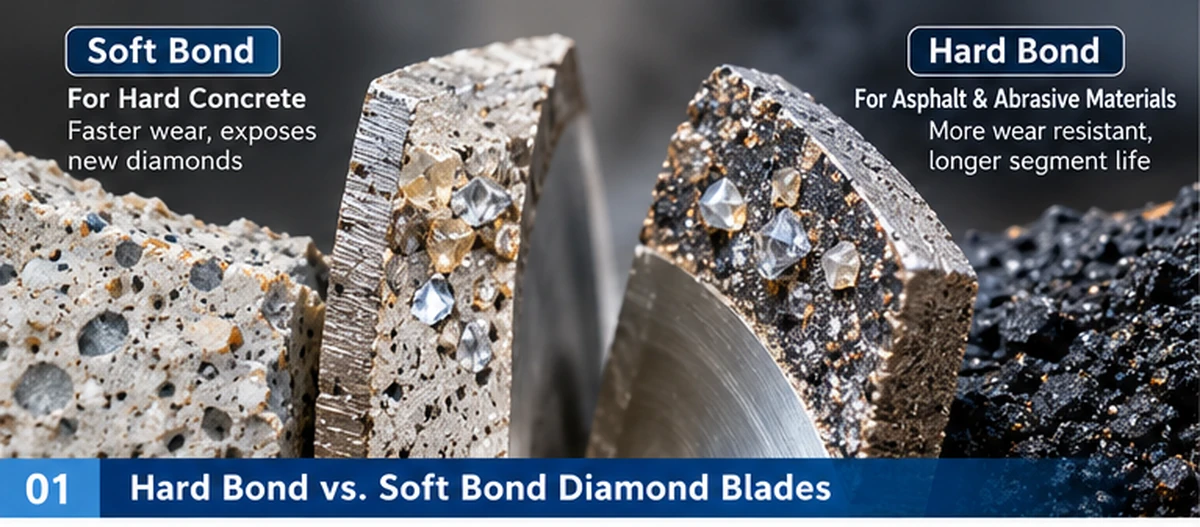
Blade cooling is only one part of performance. Learn how bond hardness affects wear and cutting speed in our Diamond Blade Bond Guide.
5. Can You Use a Wet Diamond Blade Dry?
No. A blade designated for wet cutting only must not be used dry.
Wet-only diamond blades depend on the required water supply to maintain acceptable operating temperatures.
Using these blades without water can cause excessive heating, blade damage, and potentially dangerous failure.
Do not attempt dry cutting with a wet-only blade, even for a short cut.
Can a Dry Diamond Blade Be Used Wet?
Some dry-rated diamond blades are also approved for wet cutting.
However, this must be confirmed by the blade manufacturer and the saw manufacturer’s operating instructions.
Do not assume every dry-rated blade or power tool is suitable for water exposure.
In particular, using water with electrical equipment not approved for wet operation can create an electrical hazard.
Blade Compatibility Checklist
Before cutting, verify:
- The blade’s wet/dry rating.
- The saw’s permitted operating method.
- The blade diameter and arbor fit.
- The maximum blade RPM relative to the saw spindle speed.
- The intended cutting material.
- The cooling and dust-control requirements.
- The condition of the blade, flange, and guard.
Never modify a saw or blade to permit an unapproved cutting method.
6. Diamond Blade Heat: Why Cooling Matters
Diamond blades operate under substantial mechanical and thermal loads.
During cutting, friction and resistance generate heat in the segments and steel core.
If operating temperatures become excessive, several problems may develop.
Loss of Blade Tension
Excessive heat can affect the flatness and running stability of the steel core.
Segment and Core Damage
Overheating may contribute to cracks, distortion, or damage around the blade’s cutting segments.
Reduced Cutting Efficiency
Heat buildup combined with unsuitable cutting pressure can increase friction and accelerate abnormal wear.
Increased Risk of Failure
A blade that develops cracks, distortion, loose segments, or other structural damage must be removed from service.
Never try to restore a damaged blade by cooling it and continuing to cut.
How to Reduce Overheating Risk
Use the blade within its approved operating conditions.
For wet cutting, maintain the water delivery required by the blade and saw manufacturers.
For dry cutting, follow the manufacturer’s limits on cut duration, depth, feed rate, and cooling intervals.
Never force the blade through the material.
7. Wet and Dry Cutting: OSHA Silica Dust Requirements
Cutting concrete, masonry, and other silica-containing materials can expose workers to respirable crystalline silica.
In the United States, OSHA’s construction silica standard, 29 CFR 1926.1153, establishes requirements for controlling these exposures.
Employers can follow the specified exposure-control methods in Table 1 for applicable tasks or comply through the standard’s alternative exposure-control provisions.
For several common saw categories, Table 1 specifies integrated water-delivery systems.
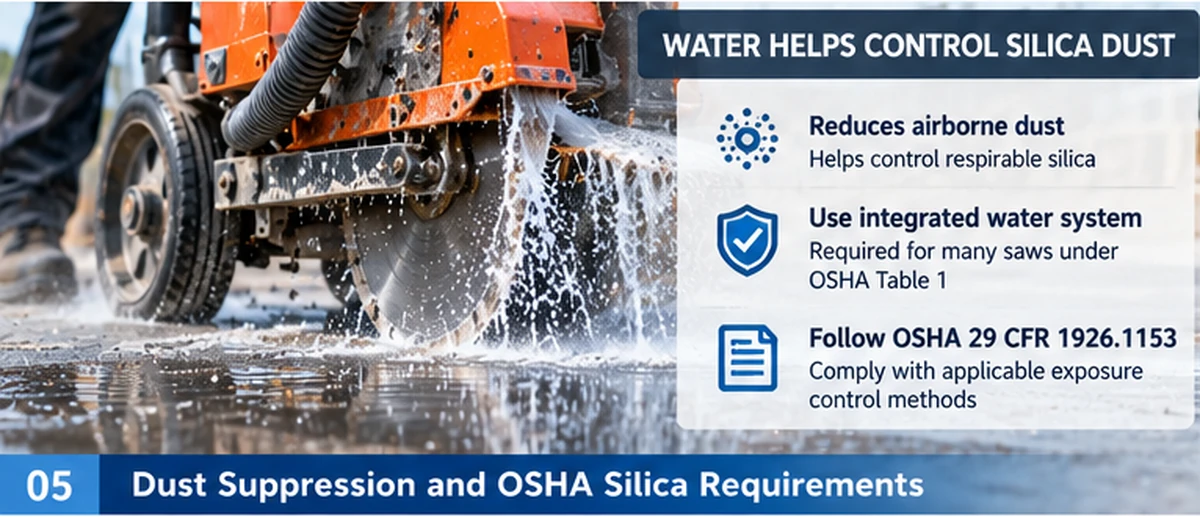
Examples include:
- Stationary masonry saws
- Handheld power saws
- Walk-behind saws
- Drivable saws
- Certain core saws and drills
The required engineering controls and respiratory protection vary by equipment type, work location, and task duration.
For example, Table 1 specifies integrated water delivery for handheld power saws. Under that prescribed approach, respiratory protection requirements differ for indoor and outdoor tasks and for work lasting more than four hours per shift.
Similarly, Table 1 specifies integrated water delivery for walk-behind saws, with additional respiratory protection requirements for indoor or enclosed-area operation.
A dry-rated blade does not exempt an employer from OSHA silica requirements.
For dry-cutting operations, contractors must establish an applicable compliant exposure-control method rather than assuming that an ordinary vacuum or disposable dust mask is sufficient.
Dust-control arrangements must be evaluated for the specific equipment and task.
For official requirements, consult OSHA’s Respirable Crystalline Silica in Construction standard and related guidance.
8. Which Diamond Cutting Method Is Best for Concrete?
For many professional concrete-cutting applications, wet cutting is a practical and effective approach when the equipment and cutting environment permit it.
It offers important benefits in cooling, debris removal, and airborne dust reduction.
Cured Concrete
Wet cutting is commonly preferred for demanding, sustained cutting of cured concrete using appropriate equipment.
Dry cutting may be possible with approved blades and equipment when a compliant dust-control method is established.
Reinforced Concrete
Reinforced concrete can impose significant cutting loads.
Use a blade specifically approved for reinforced concrete.
Wet cutting is widely used for demanding applications, but the correct method depends on the specific blade and saw.
Asphalt Pavement
Asphalt is abrasive and may produce substantial segment and core wear.
Choose an asphalt-rated diamond blade with an appropriate bond and undercut protection.
Some asphalt blade designs support dry cutting, while others are intended for wet use.
Follow the product’s specified operating method.
Brick and Concrete Block
Wet cutting is common on stationary masonry saws and helps control dust and cooling.
Some portable dry-cutting applications may be practical with specifically approved blades, equipment, and compliant dust controls.
Application Summary
| Material / Application | Commonly Suitable Method | Important Consideration |
|---|---|---|
| Cured concrete — sustained cutting | Wet cutting | Cooling and dust management |
| Reinforced concrete | Application-specific, commonly wet | Rebar-rated blade and equipment compatibility |
| Asphalt pavement | Wet or dry if approved | Abrasion and undercut resistance |
| Concrete block | Wet, or approved dry setup | High abrasiveness and silica control |
| Clay brick | Wet, or approved dry setup | Material and equipment compatibility |
| High-production walk-behind sawing | Commonly wet | Continuous cooling and site controls |
These are general guidelines. Product specifications and applicable safety requirements always take priority.
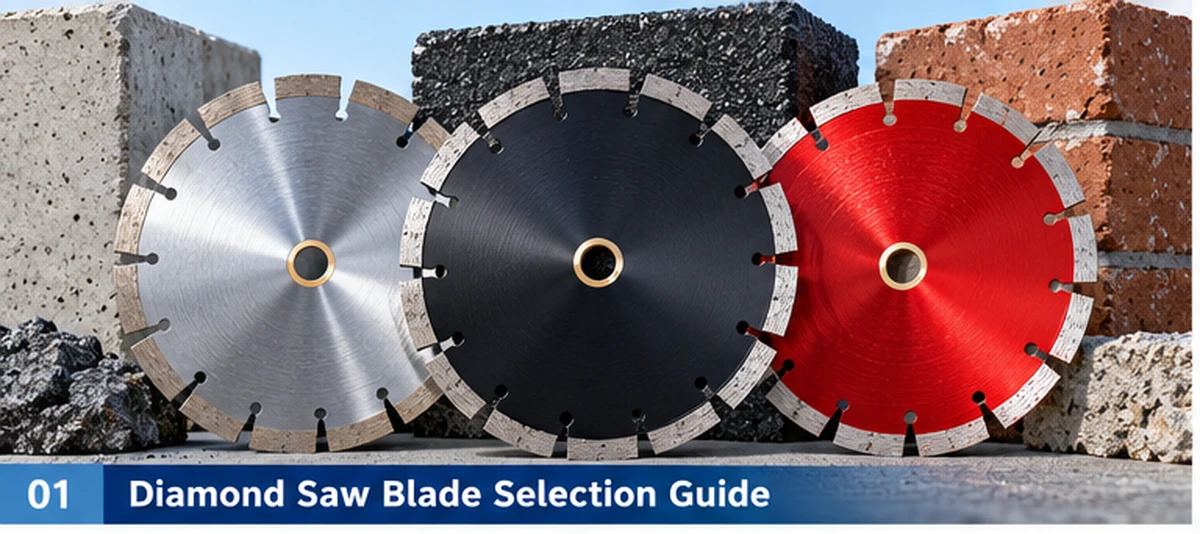
For more information about material compatibility and blade construction, read our Diamond Saw Blade Selection Guide.
9. ALSKAR DIAMOND: Choosing a Wet or Dry Cutting Blade
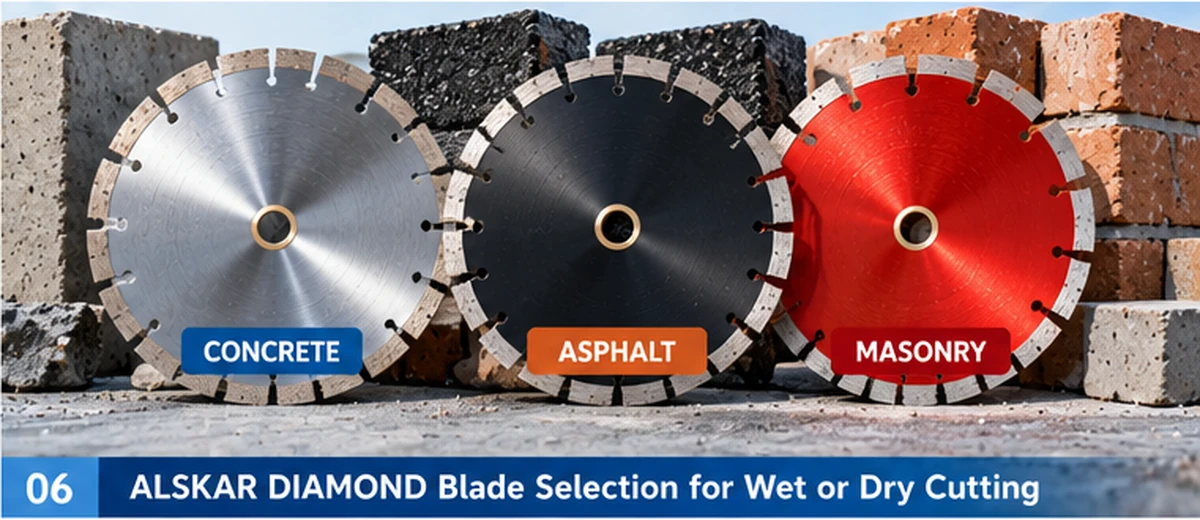
ALSKAR DIAMOND offers several diamond blade series for different construction applications.
General-Purpose Segmented Diamond Blades
Selected ALSKAR general-purpose blades are designed for wet and dry cutting of approved materials.
These options can serve contractors who need versatility across compatible saws and jobs.
Always check the exact product’s wet/dry marking and material rating.
Premium Dry-Cut Asphalt Diamond Blades
The ALSKAR Premium Dry-Cut Asphalt series is designed for abrasive asphalt-cutting conditions.
The blade design includes features such as slanted undercut protection and wide gullets.
Select the correct diameter and confirm the saw’s power, arbor, operating speed, and dust-control requirements.
Professional Concrete Walk-Behind Blades
ALSKAR Premium and Supreme Pro Concrete blade series are intended for professional wet cutting.
The Premium series is designed for suitable walk-behind saws up to 35 HP.
The Supreme series is intended for suitable walk-behind saws in the 35–65 HP range.
These professional blade series include bond options for different concrete and aggregate characteristics.
They must be used according to their wet-cutting requirements.
Other Specialized Diamond Blades
For masonry, combination cutting, hydraulic saws, or other specialized applications, choose the blade based on the published specifications of the individual product.
Do not assume that all ALSKAR blades share the same cutting-method approval.
10. How to Choose Between Wet and Dry Diamond Cutting
Before starting a project, consider the following questions.
What material are you cutting?
Identify concrete, asphalt, masonry, reinforcement, and material abrasiveness.
What equipment will be used?
Confirm the model, power, spindle speed, arbor, blade diameter, and wet/dry approval.
Is the blade specifically rated for the method?
A wet-only blade requires water. A dry-rated blade must be operated within its published limits.
Can the jobsite support effective water delivery?
Consider water availability, electrical safety, slurry collection, drainage, environmental restrictions, and nearby finished surfaces.
What dust-control requirements apply?
Identify applicable OSHA requirements and establish appropriate engineering and work-practice controls before cutting.
How demanding is the cutting task?
Extended high-load cutting may require a different blade or operating method than an occasional shallow cut.
What provides the lowest total project cost?
Consider blade life, cutting speed, labor, setup, cleanup, and compliance-related requirements.
11. Final Recommendations
Wet cutting and dry cutting are not interchangeable operating methods.
Wet cutting offers advantages in heat removal, debris management, and airborne dust reduction when an appropriate water-delivery system is used.
Dry cutting can be practical when the blade and equipment are designed for the application and compliant dust controls are implemented.
Neither method is universally best.
Choose the cutting method based on the blade’s published rating, saw compatibility, material characteristics, operating demands, and jobsite safety requirements.
For professional cutting applications, using the correct blade and following the manufacturer’s instructions are essential to obtaining consistent performance.
Frequently Asked Questions
Is wet cutting better than dry cutting for concrete?
Wet cutting is often preferred for sustained professional concrete cutting because it helps cool the blade and suppress dust. Dry cutting may be appropriate with compatible equipment, a dry-rated blade, and compliant dust controls.
Can I use a wet diamond blade without water?
No. Wet-only diamond blades require the specified water supply. Dry operation can cause excessive heat, damage, or blade failure.
Can dry diamond blades be used with water?
Some dry-rated blades can also be used wet, but only when both the blade and saw manufacturers approve wet operation.
Does wet cutting make diamond blades last longer?
Wet cutting can improve blade life through cooling and debris removal. Actual service life also depends on bond formulation, blade construction, material characteristics, and operating conditions.
Do dry diamond blades need dust control?
Yes. Cutting silica-containing materials can generate hazardous respirable dust. Employers must implement applicable OSHA-compliant exposure controls.
Can I dry cut reinforced concrete?
Only when the blade and saw are specifically approved for the application and applicable dust-control requirements are satisfied.
Why does my dry-cutting diamond blade overheat?
Possible causes include excessive pressure, prolonged operation beyond the approved duty cycle, incorrect speed, poor blade selection, or an application mismatch.
What is the best blade for wet cutting concrete?
Choose a concrete-rated wet-cutting blade matched to the aggregate, saw horsepower, diameter, arbor, RPM, and reinforcement conditions.
Explore ALSKAR DIAMOND Saw Blades
ALSKAR DIAMOND supplies diamond saw blades for concrete, asphalt, masonry, and professional construction cutting.
Explore our blade selection or contact our team with your material, saw model, blade diameter, and cutting requirements.
Technical note: This article provides general guidance. Always follow manufacturer instructions and applicable workplace safety requirements. OSHA silica exposure-control obligations depend on the actual task and work conditions.