



Stainless Steel Cutting TCT Saw Blades – 48T, 80T & 90T
Price range: $14.90 through $55.80
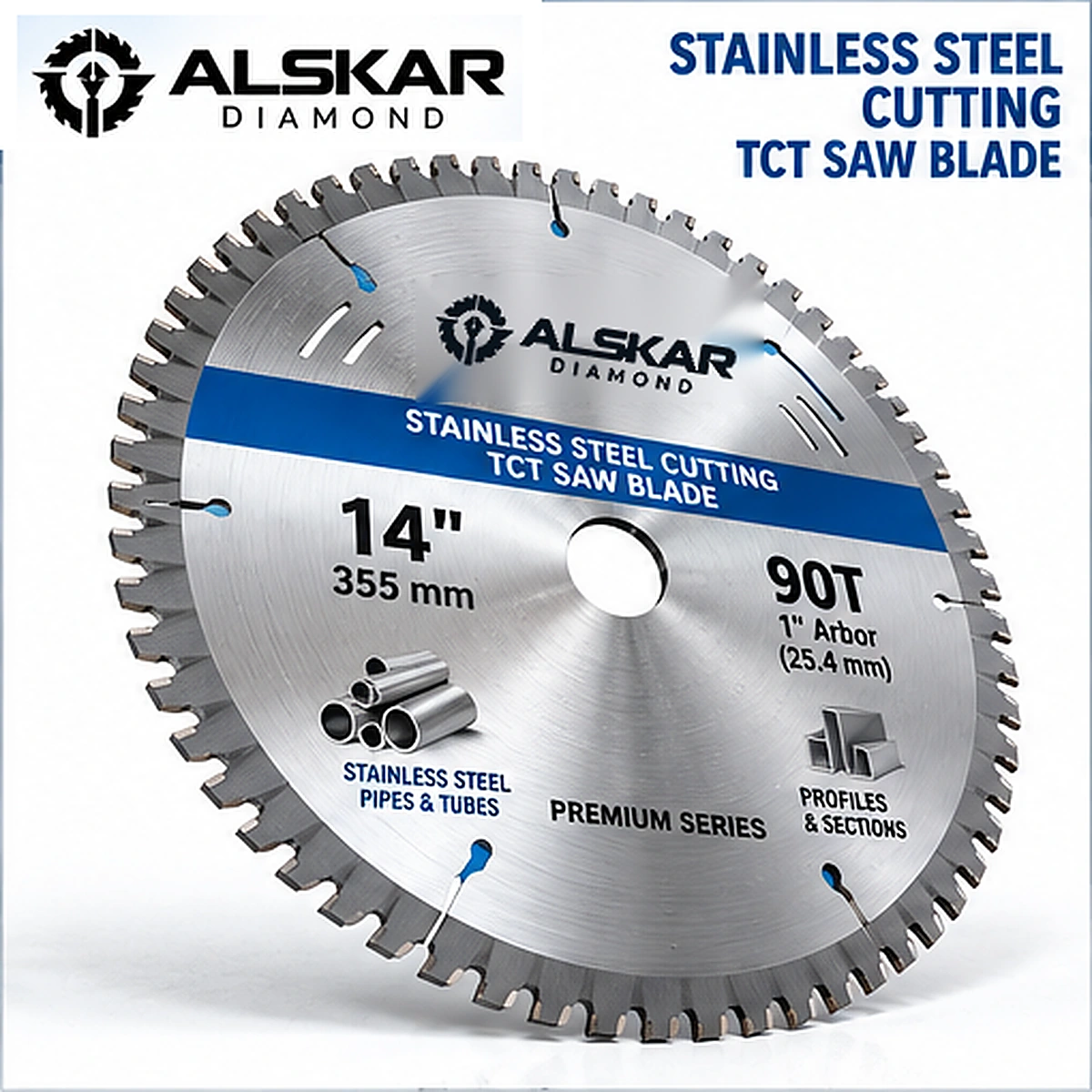
ALSKAR Stainless Steel Cutting TCT Saw Blades are developed for professional cutting of compatible stainless steel pipes, round and square tubing, and selected stainless steel profiles.
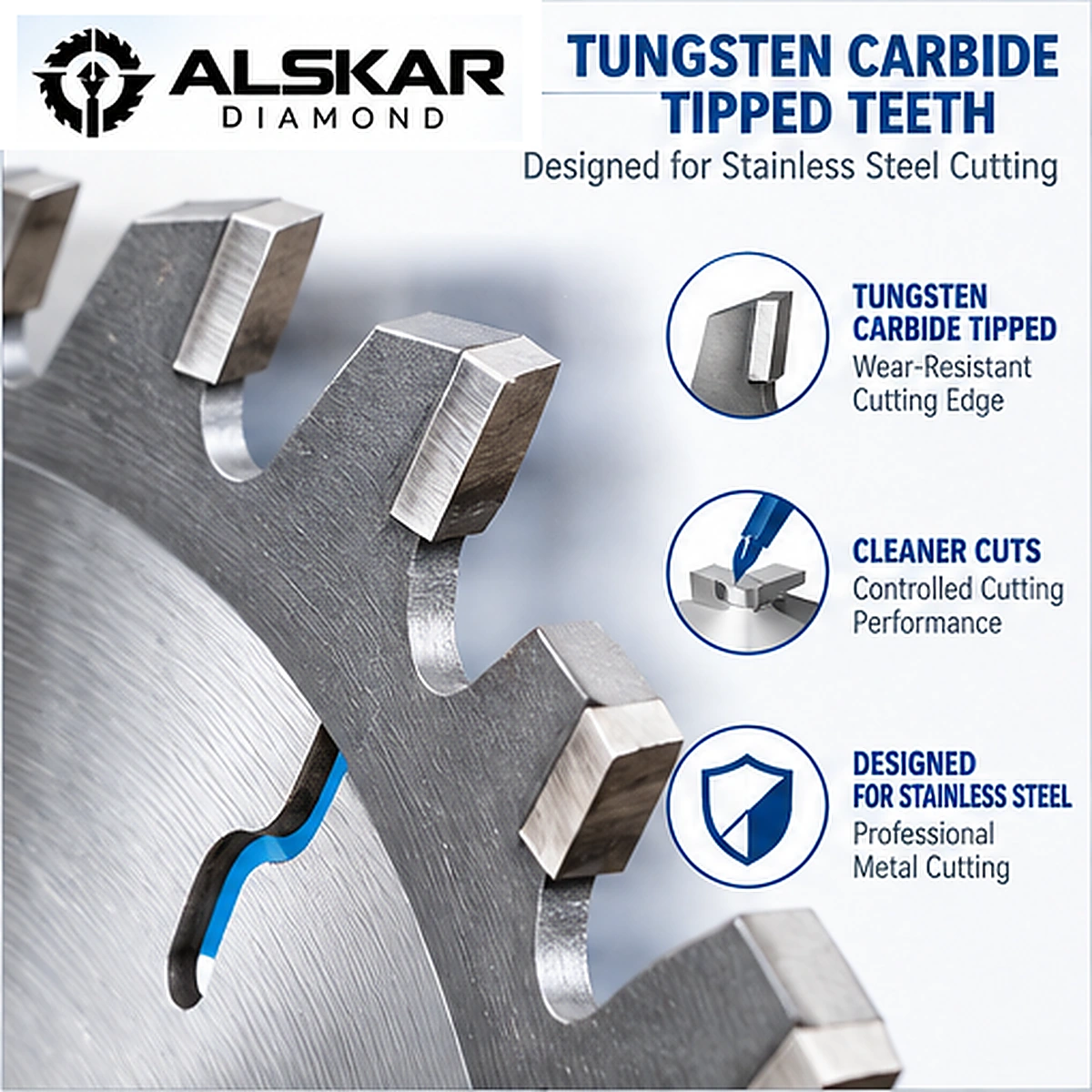
Featuring specialized tungsten carbide tipped cutting edges, this Premium series is designed for controlled cutting and consistent edge quality when used with approved metal-cutting equipment.
Key Features
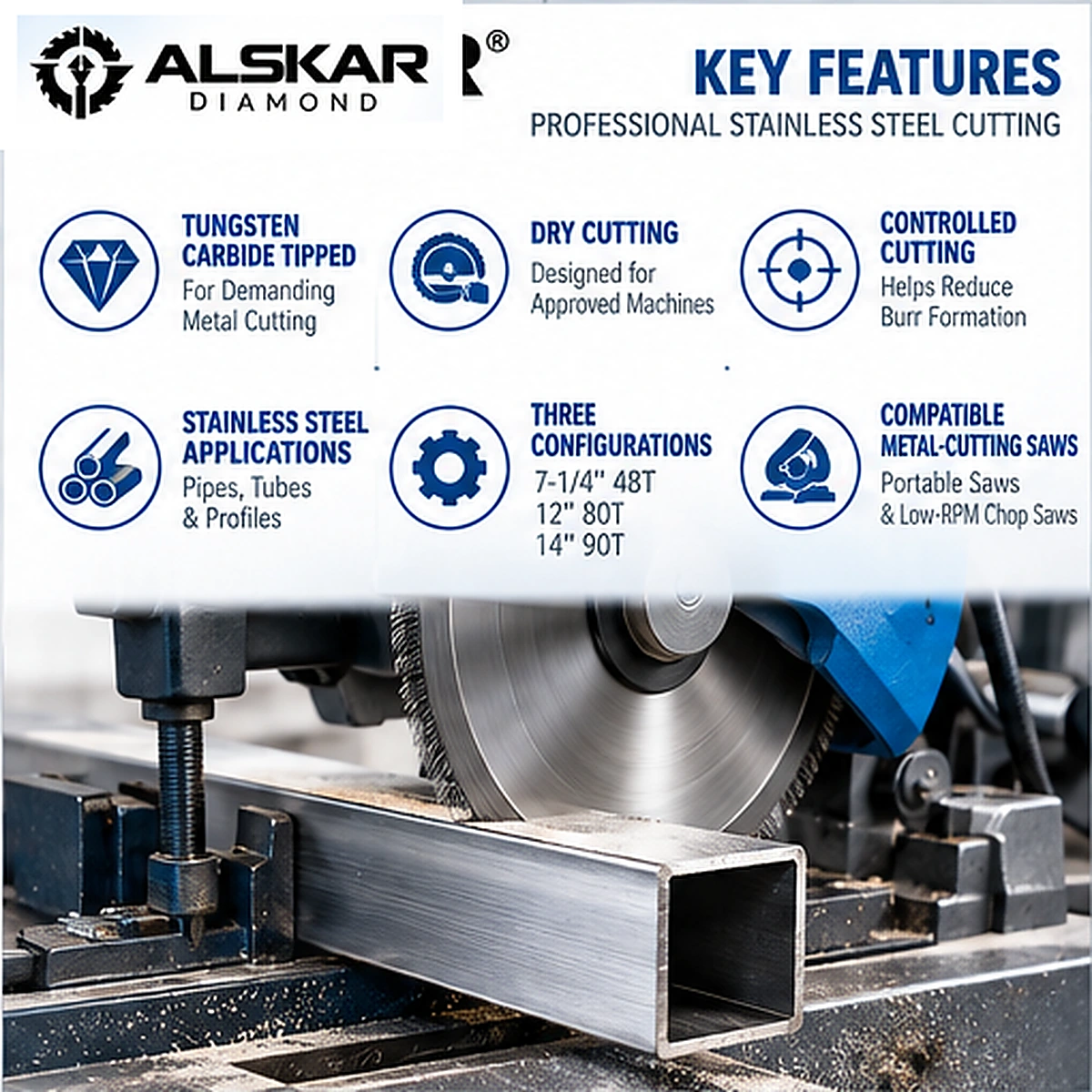
- Specialized TCT saw blades for approved stainless steel cutting applications
- Tungsten carbide tipped teeth for demanding metal-cutting conditions
- Designed for compatible stainless steel pipes, tubes, and profiles
- Dry-cutting applications on properly rated metal-cutting machines
- Selected 48T, 80T, and 90T tooth configurations
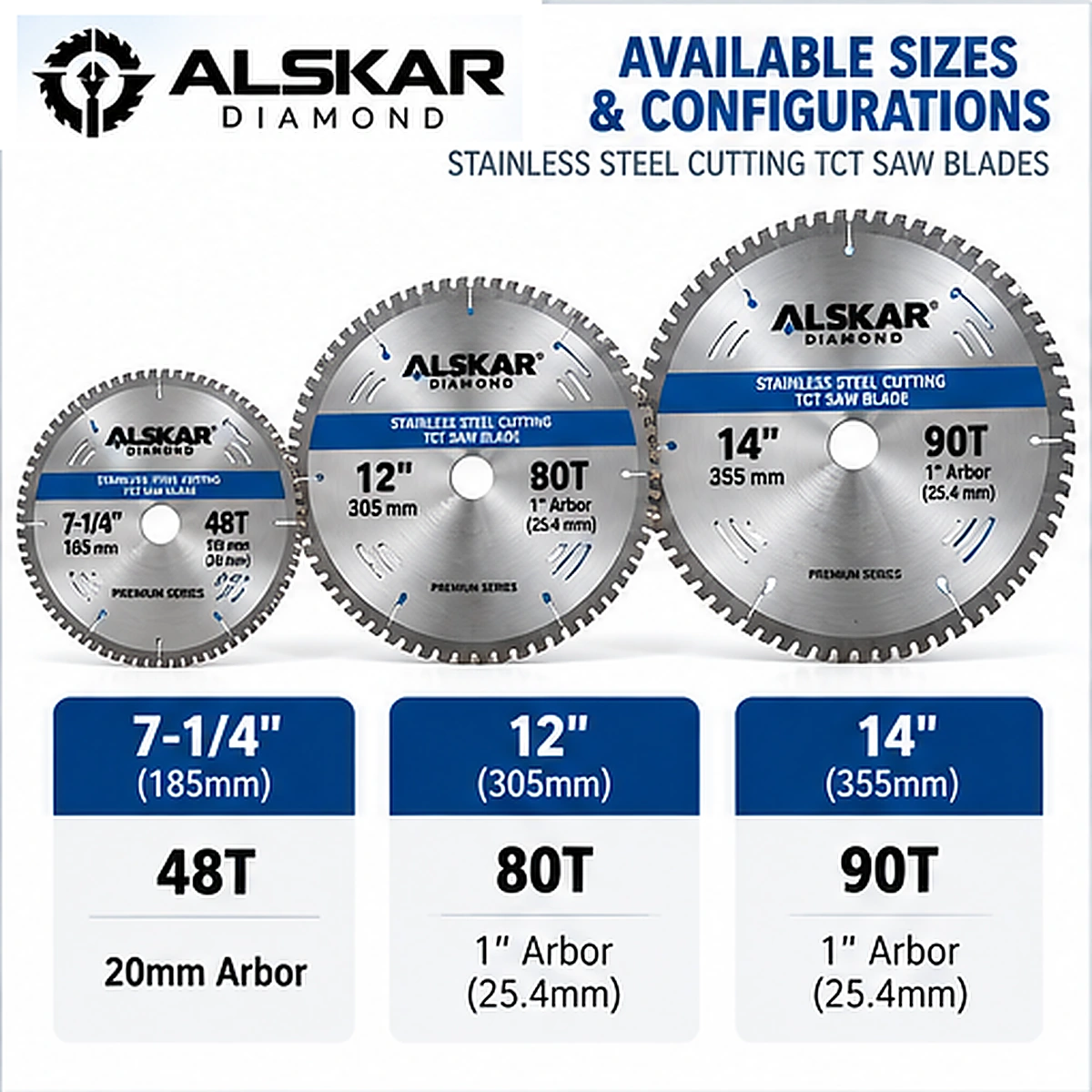
- Three planned diameters: 7-1/4″ (185mm), 12″ (305mm), and 14″ (355mm)
- 20mm arbor for the 7-1/4″ configuration
- 1″ round arbor for the 12″ and 14″ configurations
- Designed to support controlled cutting and practical edge quality under suitable conditions
- Suitable for professional stainless steel fabrication and industrial metalworking applications
- Dedicated blade selection for compatible portable metal saws and low-RPM metal-cutting chop saws
Selected Configurations
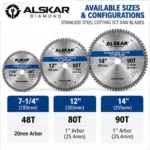
- 7-1/4″ (185mm) × 48T × 20mm Arbor
- 12″ (305mm) × 80T × 1″ Arbor
- 14″ (355mm) × 90T × 1″ Arbor
Important: Final specifications and material compatibility are subject to factory confirmation. Verify stainless steel grade, material dimensions, blade diameter, arbor, maximum RPM, and machine compatibility before cutting. Not intended for ordinary high-speed abrasive cut-off saws.
1. Stainless Steel Cutting TCT Saw Blades
Professional Carbide-Tipped Cutting Solutions for Stainless Steel Pipes, Tubes & Profiles
ALSKAR Stainless Steel Cutting TCT Saw Blades are developed for professional metal fabrication applications where controlled cutting, dimensional accuracy, and consistent edge quality are important.
Designed for compatible stainless steel pipes, tubing, and selected profiles, this Premium series features tungsten carbide tipped cutting edges and application-specific blade configurations.
The selected product range includes a 7-1/4″ 48T blade for compatible portable metal-cutting saws, a 12″ 80T blade for selected professional metal-cutting machines, and a 14″ 90T blade for suitable low-RPM metal-cutting chop saws.
Each configuration must be matched to the intended stainless steel grade, material dimensions, machine speed, and approved operating conditions.
2. Key Features & Benefits
1. Specialized for Stainless Steel Cutting
Stainless steel presents demanding cutting conditions due to its material properties, cutting forces, potential work hardening, and heat generation.
Unlike general-purpose wood or aluminum saw blades, this series is developed around the requirements of compatible stainless steel cutting applications.
The actual cutting-tip material and tooth geometry must be validated for the intended stainless steel grades.
2. Tungsten Carbide Tipped Teeth
The proposed blade construction features tungsten carbide tipped cutting teeth suitable for demanding metal-cutting applications.
Correct carbide grade, tooth geometry, tip attachment, and cutting parameters are important for maintaining cutting-edge integrity and reducing premature wear.
Actual performance and blade service life depend on the material, machine, feed conditions, and blade maintenance.
3. Controlled Dry-Cutting Applications
The series is intended for approved dry-cutting operations using compatible metal-cutting equipment.
When the selected blade is rated for dry cutting, it can be used according to the manufacturer’s instructions without a required liquid coolant system.
Dry cutting can still generate heat, sparks, and sharp metal chips. Proper machine guarding, clamping, and workplace safety controls are essential.
4. Designed for Stainless Steel Pipes & Tubing
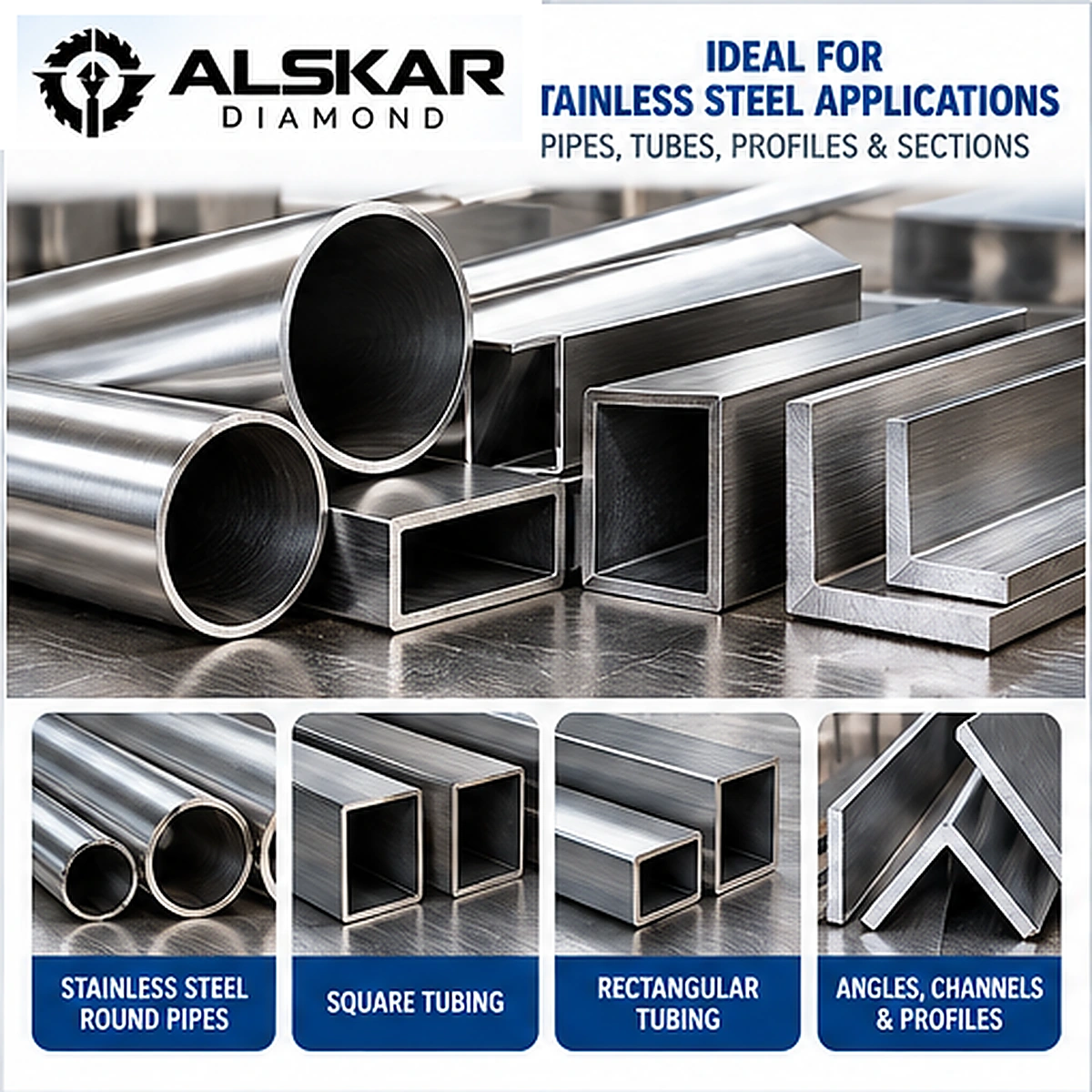
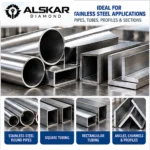
This series focuses on compatible stainless steel pipes, round tubing, square tubing, rectangular tubing, and selected profiles.
Suitable blade selection and secure workpiece support help maintain cutting accuracy and reduce unwanted vibration during operation.
5. Three Selected Blade Configurations
The ALSKAR development range includes:
- 7-1/4″ (185mm) × 48T × 20mm Arbor
- 12″ (305mm) × 80T × 1″ Arbor
- 14″ (355mm) × 90T × 1″ Arbor
These configurations serve different machine and cutting requirements.
Blade diameter and tooth count alone do not establish machine compatibility.
6. Professional Cutting & Edge Quality
The proposed blade series is designed to support controlled cutting of appropriate stainless steel sections.
With suitable equipment, sharp cutting edges, correct blade geometry, and proper feeding conditions, users can achieve practical cutting accuracy and edge quality.
Cut quality and burr formation depend on the stainless steel grade, blade condition, machine alignment, and cutting setup.
7. Application-Specific Equipment Compatibility
The 7-1/4″ model is intended for evaluation with compatible portable metal-cutting circular saws.
The 12″ and 14″ models are intended for suitable professional metal-cutting equipment, particularly machines designed for carbide-tipped steel cutting.
These blade groups have different speed and mounting requirements and must not be treated as universally interchangeable.
3. Recommended Materials
Primary Application Category
- Compatible Stainless Steel Pipes
- Stainless Steel Round Tubing
- Stainless Steel Square Tubing
- Stainless Steel Rectangular Tubing
- Selected Stainless Steel Profiles
- Compatible Hollow Stainless Steel Sections
- Selected Stainless Steel Flat Stock, subject to model approval
Target Stainless Steel Grades for Product Qualification
- AISI 302
- AISI 303
- AISI 304
These grades are proposed validation targets. They are not yet approved for every ALSKAR configuration.
Materials Requiring Separate Validation
- AISI 316 / 316L Stainless Steel
- Duplex Stainless Steel
- Hardened Stainless Steel
- High-Strength Stainless Alloys
- Specialty Stainless Steel Grades
- Solid Bar or Heavy-Wall Sections Outside the Approved Cutting Capacity
Never assume that a blade approved for one stainless steel grade is automatically suitable for every stainless alloy.
4. Recommended Applications
Stainless Steel Pipe Cutting
Crosscutting suitable stainless steel pipes used in fabrication, mechanical installations, and industrial assemblies.
Round & Square Tube Cutting
Cutting compatible round, square, and rectangular stainless steel tubing with appropriate material support and clamping.
Architectural Stainless Steel Fabrication
Preparing approved stainless steel tubes and profiles for railings, architectural components, decorative frameworks, and related fabrication work.
Professional Metalworking
Cutting selected stainless steel sections for workshop production, welding preparation, and manufactured assemblies.
Industrial & Construction Applications
Processing suitable stainless steel components on professional cutting machines specifically approved for the selected material and blade.
5. Available Blade Configurations
| Blade Diameter | Metric Diameter | Teeth | Arbor | 7-1/4″ | 185mm | 48T | 20mm | 12″ | 305mm | 80T | 1″ Round | 14″ | 355mm | 90T | 1″ Round |
|---|
All listed configurations are ALSKAR’s selected development specifications. Final commercial specifications and availability are subject to production verification.
6. Technical Specifications
| Specification | Details |
|---|---|
| Brand | ALSKAR DIAMOND |
| Product Type | Stainless Steel Cutting TCT Saw Blade |
| Proposed Quality Grade | Premium |
| Blade Diameters | 7-1/4″ / 12″ / 14″ |
| Metric Diameters | 185mm / 305mm / 355mm |
| Tooth Counts | 48T / 80T / 90T |
| 7-1/4″ Arbor | 20mm |
| 12″ Arbor | 1″ Round |
| 14″ Arbor | 1″ Round |
| Cutting Tips | Tungsten Carbide Tipped |
| Blade Body | Steel |
| Main Application | Compatible Stainless Steel Materials |
| Cutting Method | Dry, Subject to Product Approval |
| Tooth Geometry | To Be Confirmed |
| Carbide Grade | To Be Confirmed |
| Kerf Width | To Be Confirmed by Model |
| Plate Thickness | To Be Confirmed by Model |
| Hook Angle | To Be Confirmed by Model |
| Maximum RPM | Refer to the Actual Supplied Blade |
| Approved Stainless Steel Grades | Subject to Material Validation |
| Machine Compatibility | Approved Metal-Cutting Saws |
7. How to Choose the Right Blade Configuration
7-1/4″ × 48T — Portable Stainless Steel Cutting
A compact blade configuration intended for compatible portable metal-cutting circular saws.
This model is positioned for selected stainless steel tube and profile cutting applications where portable equipment is required.
The machine must support the 185mm blade diameter, 20mm arbor, approved operating speed, and intended cutting material.
12″ × 80T — Professional Stainless Steel Cutting
A medium-diameter configuration intended for compatible professional metal-cutting machines.
This model is positioned for selected stainless steel pipes, tubing, and profiles within the approved cutting capacity.
Verify the 305mm blade diameter, 1″ mounting bore, and machine speed before installation.
14″ × 90T — Heavy-Duty Professional Saw Configuration
The 14″ configuration is intended for suitable low-RPM metal-cutting chop saws and professional workshop operations.
Its larger diameter supports applications requiring the cutting capacity of compatible 14″ class machines.
The blade must be validated for the intended material and equipment. Larger diameter does not automatically mean the blade is approved for every heavy-wall or solid stainless steel workpiece.
8. Stainless Steel TCT vs. Mild Steel TCT Saw Blades
Stainless Steel Cutting TCT Series
Developed for the specific demands of compatible stainless steel alloys, with an emphasis on appropriate carbide material, tooth geometry, cutting speed, and workpiece support.
Dry-Cut Mild Steel TCT Series
Designed for approved low-carbon steel pipes, tubing, angles, channels, and related structural sections.
Although both series use carbide-tipped cutting technology, the materials and operating requirements are not identical.
A blade designed for mild steel should not be assumed suitable for stainless steel without explicit product approval.
9. Stainless Steel TCT vs. Cermet Saw Blades
Tungsten Carbide Tipped (TCT)
Uses tungsten carbide-based cutting tips intended for the applicable cutting material and operating conditions.
Cermet-Tipped
Uses ceramic-metal composite cutting materials developed for specific wear and cutting requirements.
The two technologies are not identical. ALSKAR products should be described according to their actual cutting-tip composition.
10. How to Select the Correct Stainless Steel Saw Blade
Step 1 — Identify the Stainless Steel Grade
Confirm the exact stainless steel alloy, such as AISI 304 or another specified grade.
Step 2 — Check the Workpiece Dimensions
Determine whether the workpiece is round tubing, square tubing, pipe, profile, sheet, or solid stock.
Record the wall thickness or material cross-section.
Step 3 — Verify the Cutting Equipment
Check that the machine is explicitly approved to cut the selected stainless steel material with a compatible carbide-tipped blade.
Step 4 — Select the Correct Blade Diameter
Choose the blade diameter specified by the machine manufacturer.
Step 5 — Confirm the Arbor
Verify the spindle diameter, blade center hole, mounting flanges, and any additional machine-specific mounting requirements.
Step 6 — Check Tooth Geometry & Cutting Conditions
Select a configuration suited to the steel grade, workpiece geometry, machine operating speed, and required cutting method.
Step 7 — Confirm Maximum RPM
Never exceed the maximum RPM marked on the actual blade.
The blade must also be suitable for the machine’s operating speed; a maximum-RPM rating alone does not establish that the saw/blade combination will cut correctly or safely.
Step 8 — Secure the Workpiece
Use suitable material clamping and support. Follow the approved feed rate, cutting direction, guarding, and cutting procedure.
11. Operating & Safety Recommendations
- Use only machines specifically approved for the selected metal-cutting blade.
- Confirm that the blade is rated for the intended stainless steel grade.
- Check the actual blade diameter, arbor, and mounting system.
- Follow the blade and machine manufacturer’s rotation-direction requirements.
- Do not exceed the maximum RPM marked on the supplied blade.
- Follow the approved operating speed and feed recommendations.
- Secure the stainless steel workpiece before cutting.
- Support long pipes, tubing, and irregular profiles.
- Use all required blade guards and machine safety devices.
- Keep hands clear of the blade and chip-discharge area.
- Control sparks, heat, sharp chips, and hot offcuts.
- Keep flammable materials away from the work area.
- Wear appropriate eye, face, hearing, and other personal protection.
- Inspect the blade body and carbide tips before operation.
- Do not use blades with chipped teeth, cracks, deformation, or other damage.
- Do not use on unsupported materials or equipment.
- Follow all applicable workplace safety requirements.
12. Why Choose ALSKAR DIAMOND?
ALSKAR DIAMOND supplies professional cutting tools for metal fabrication, woodworking, construction, stone processing, and industrial applications.
Our Stainless Steel Cutting TCT Saw Blade Series is being developed around three selected professional configurations, emphasizing application-specific product selection, proper machine compatibility, and controlled cutting performance.
For technical recommendations, wholesale quotations, or distributor inquiries, contact ALSKAR DIAMOND with your stainless steel grade, workpiece dimensions, saw model, blade diameter, arbor requirements, and estimated order quantity.
13. Frequently Asked Questions
What are stainless steel cutting TCT saw blades?
Stainless steel cutting TCT saw blades
feature tungsten carbide tipped cutting
teeth developed for compatible stainless
steel cutting applications.
They must be used with correctly rated
metal-cutting equipment and approved
cutting conditions.
What sizes and tooth counts are offered?
The selected ALSKAR development range includes:
7-1/4″ (185mm) × 48T × 20mm arbor,
12″ (305mm) × 80T × 1″ arbor,
14″ (355mm) × 90T × 1″ arbor.
Final commercial specifications and
availability are subject to confirmation.
Can these blades cut 304 stainless steel?
AISI 304 is one of the target grades for
product qualification.
Actual compatibility must be confirmed
for the supplied blade, machine, workpiece
dimensions, and operating conditions
before cutting.
Can these blades cut 316 stainless steel?
Do not assume compatibility with AISI 316
or 316L stainless steel.
Use only a blade and machine combination
specifically approved for the intended
stainless steel grade.
Are these blades suitable for stainless
steel pipes and square tubing?
Selected configurations are intended
for suitable stainless steel pipes,
round tubing, square tubing, rectangular
tubing, and approved profiles.
Verify the alloy, wall thickness, machine,
and blade specifications before use.
What is the difference between mild steel
and stainless steel TCT saw blades?
Mild steel cutting blades are designed
primarily for compatible low-carbon steel.
Stainless steel blades require cutting-edge
construction and operating conditions
appropriate for the intended stainless
steel alloy.
These products should not be considered
automatically interchangeable.
Can these blades be used for dry cutting?
The series is intended for dry-cutting
applications where the selected blade
and machine are specifically approved.
Always follow the actual blade and machine
manufacturer’s cutting instructions.
Can I install one of these blades
on an abrasive chop saw?
Not unless both the saw manufacturer
and blade manufacturer explicitly
approve that exact combination.
Abrasive cut-off machines and carbide-tipped
metal-cutting machines can have different
operating speed and safety requirements.
Are stainless steel TCT blades spark-free?
No. Cutting stainless steel can generate
heat, sparks, and sharp metal chips.
Follow all machine instructions and
workplace safety requirements.
What is the maximum operating RPM?
Maximum RPM is model-specific.
Refer to the actual supplied blade marking
and verified technical specifications.
Never use an assumed rating from another
brand or blade diameter.
What is the difference between TCT
and Cermet saw blades?
TCT blades use tungsten carbide tipped
cutting edges.
Cermet blades use ceramic-metal composite
cutting materials.
Selection depends on the actual blade
construction, material, and approved
operating conditions.
Why do stainless steel saw blades
require special cutting conditions?
Stainless steel may present demanding
cutting conditions due to work hardening,
heat generation, and cutting forces.
Correct blade geometry, feed rate,
clamping, and machine compatibility
are essential.
Are wholesale and distributor inquiries
available?
Yes. Contact ALSKAR DIAMOND with your
stainless steel grade, workpiece dimensions,
blade diameter, arbor, cutting machine,
estimated quantity, and destination market.
Final specifications, availability,
and pricing will be confirmed
during quotation.
| Blade Configuration | 7-1/4″ – 48T – 20mm Arbor, 12″ – 80T – 1″ Arbor, 14″ – 90T – 1″ Arbor |
|---|---|
| Quality Grade | Premium |
| Blade Type | Stainless Steel Cutting TCT |
| Cutting Tips | Tungsten Carbide Tipped |
| Cutting Method | Dry, Subject to Approval |
| Primary Application | Stainless Steel Cutting |
| Machine Application | Approved Metal-Cutting Saws |
Related products


General Purpose & Combination TCT Wood Saw Blades
Price range: $9.00 through $33.00
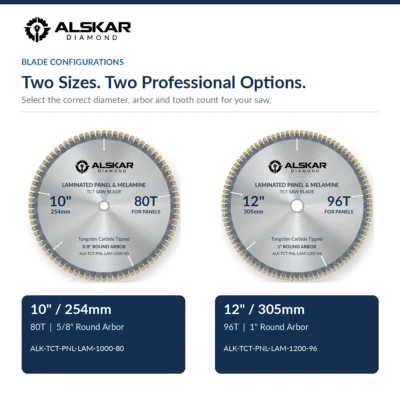
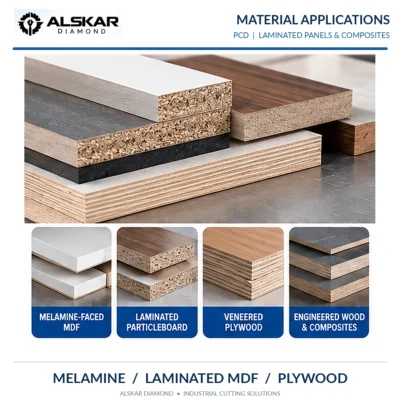
Laminated Panel & Melamine TCT Saw Blades – 80T & 96T
Price range: $30.10 through $51.00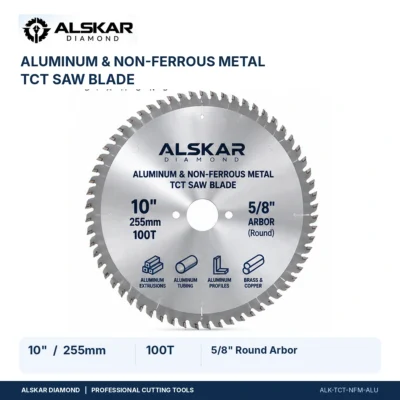
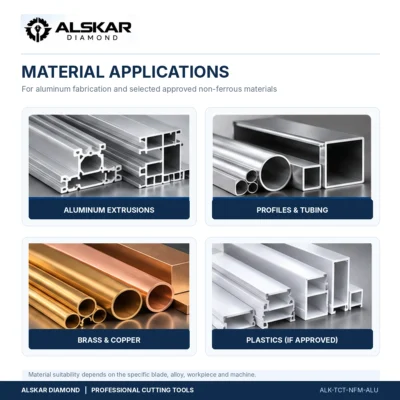
Non-Ferrous Metal & Aluminum TCT Saw Blades – 60T to 100T
Price range: $14.70 through $45.80
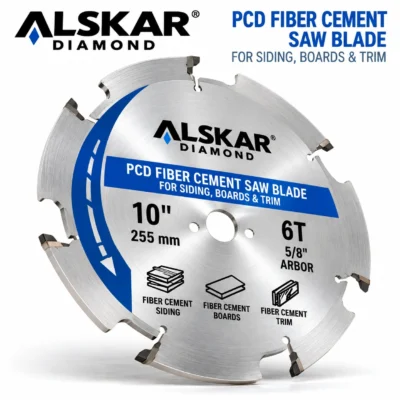
PCD Fiber Cement Saw Blades – 4T, 6T & 8T
Price range: $46.90 through $95.00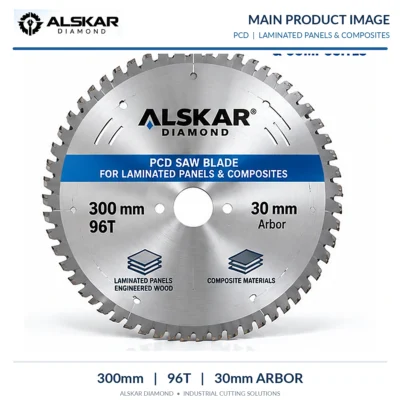
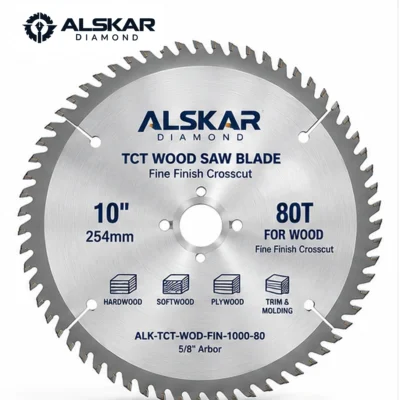

TCT Fine Finish Crosscut Wood Saw Blades – 60T to 100T
Price range: $9.60 through $36.50
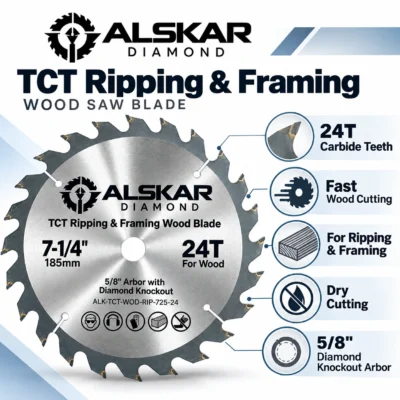
TCT Ripping & Framing Wood Saw Blades – 24T
Price range: $8.20 through $9.00
Reviews
There are no reviews yet.