Diamond Blade Bond Explained: Hard Bond vs. Soft Bond

Diamond Blade Bond Explained: Hard Bond vs. Soft Bond
Understanding Metal Bond Hardness, Diamond Exposure, Concrete Aggregate Selection, and Blade Performance
Why does a diamond saw blade cut one type of concrete efficiently but struggle with another?
Why can a blade designed for asphalt wear rapidly when used on the wrong material? And why does a diamond blade sometimes stop cutting even though its segments still appear to have plenty of height?
In many cases, the answer involves the diamond blade bond.
The bond is a critical component of a diamond cutting segment. It controls how diamonds are retained, supported, and gradually exposed during cutting.
Understanding the difference between hard and soft bonds helps contractors choose the correct diamond blade, maintain cutting productivity, and avoid premature blade wear.
This guide explains how diamond blade bonds work, when to use a hard or soft bond, and how to select a suitable bond for different concrete and pavement cutting conditions.
1. What Is a Diamond Blade Bond?
A diamond blade bond is the material that holds industrial diamond particles in the cutting segment or rim.
In conventional metal-bond diamond segments, diamonds are distributed within a metallic matrix manufactured using selected metal powders and processing methods.

The exact bond formulation influences the segment’s mechanical properties and wear behavior.
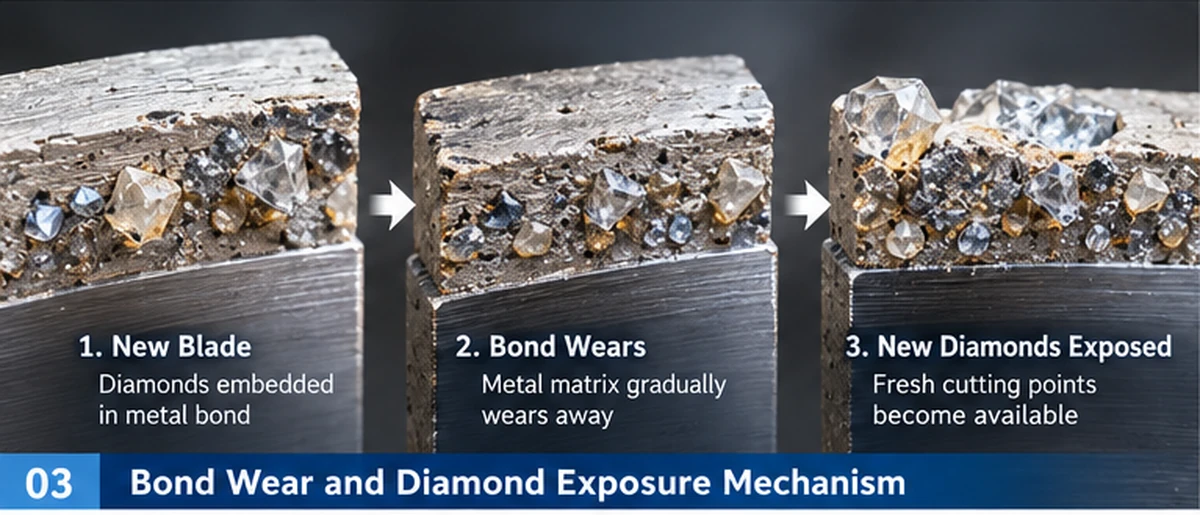
During cutting, exposed diamonds abrade the concrete, stone, or other material. As diamonds become worn or fractured, controlled wear of the surrounding bond helps expose new cutting points.
This cycle is essential to the performance of a conventional diamond blade.
A correctly matched bond provides a balance between two competing requirements:
- Diamond retention: Holding usable diamonds securely during cutting.
- Diamond exposure: Allowing worn cutting points to be replaced by newly exposed diamonds.
If the bond wears too slowly, the blade may stop cutting efficiently.
If the bond wears too rapidly, diamonds and segment material may be lost prematurely.
The goal is not simply to produce the hardest possible metal bond. The goal is to produce a bond that wears at an appropriate rate for the intended application.
2. Hard Bond vs. Soft Bond: What’s the Difference?
The terms hard bond and soft bond refer primarily to the bond’s intended wear behavior during cutting.
They should not be confused with the hardness of the diamonds themselves.
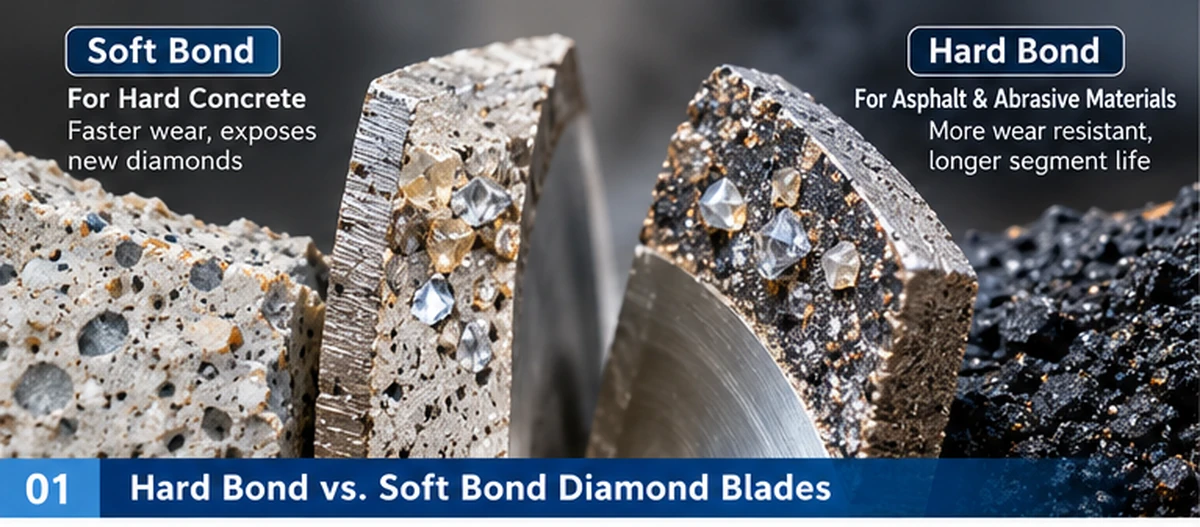
Hard Bond Diamond Blades
A hard bond is designed to resist abrasion and retain the diamond-bearing matrix for a longer period under its intended cutting conditions.
Harder, more wear-resistant bonds are often selected for highly abrasive materials such as asphalt and green concrete.
Because these materials can aggressively wear cutting segments, a more wear-resistant bond helps control segment consumption.
However, a bond that is too resistant to wear for a particular material may fail to expose fresh diamonds efficiently.
This can produce slow cutting and glazing.
Soft Bond Diamond Blades
A soft bond is designed to wear more readily under the intended cutting conditions.
This helps expose fresh diamond particles when the cutting material does not naturally abrade the metal matrix fast enough.
Softer bonds are frequently used for hard, relatively less-abrasive materials, including certain cured concretes containing hard aggregates.
If an excessively soft bond is used on highly abrasive material, the segment may wear rapidly and blade life may be reduced.
Hard Bond vs. Soft Bond Comparison
| Characteristic | Hard Bond | Soft Bond |
|---|---|---|
| Bond wear resistance | Generally higher | Generally lower |
| Metal matrix erosion | Slower under comparable conditions | Faster under comparable conditions |
| Diamond exposure | More gradual | More readily renewed |
| Common application | Highly abrasive materials | Harder, less-abrasive materials |
| Typical examples | Asphalt, green concrete | Hard cured concrete, hard aggregate |
| Risk with incorrect selection | Glazing and slow cutting | Rapid segment wear |
| Primary objective | Control premature matrix loss | Maintain effective diamond exposure |
These are general principles. Actual performance depends on diamond characteristics, segment formulation, material abrasiveness, cooling, machine power, and operating conditions.
3. Why Hard Concrete Often Requires a Soft Bond
This is one of the most important concepts in diamond blade selection.
Hard concrete does not automatically require a harder diamond blade bond.
In fact, the opposite is frequently true.
When cutting dense cured concrete containing hard, relatively less-abrasive aggregate, the material may wear the metal matrix too slowly.
Exposed diamonds gradually become worn or polished while the surrounding bond continues to hold them.
Without sufficient bond erosion, fewer new cutting points become available.
As a result, cutting speed may decrease.
A softer bond can help expose new diamond crystals more consistently and maintain cutting efficiency.
However, concrete compressive strength alone does not determine the appropriate bond.
Other important factors include:
- Aggregate mineralogy and hardness
- Aggregate size and distribution
- Sand abrasiveness
- Concrete age and curing condition
- Reinforcement
- Blade diameter and saw horsepower
- Cutting depth and cooling method
For example, two concrete slabs with similar compressive strength may require different bond formulations because their aggregate and abrasive characteristics differ.
Contractor tip: When selecting a professional concrete blade, ask about aggregate hardness and abrasiveness—not only concrete PSI.
4. Why Asphalt and Green Concrete Often Require a Hard Bond
Asphalt and green concrete frequently create abrasive cutting conditions.
During cutting, abrasive material and loose particles may erode the metal bond rapidly.
If the bond is too soft for the application, it can wear away before the diamonds have delivered their expected useful service.
This leads to unnecessary segment consumption and reduced blade life.
A harder, more abrasion-resistant bond helps control matrix wear.
Asphalt Cutting
Asphalt can be especially demanding because of its abrasive cutting conditions.
Dedicated asphalt blades commonly combine wear-resistant segment formulations with undercut protection.
Undercutting occurs when abrasive material erodes the steel core just beneath the cutting segments.
Excessive undercutting can weaken the area supporting the segments and create a serious blade integrity risk.
Use an asphalt-rated blade with suitable core protection and inspect the blade regularly.
Green Concrete Cutting
Green concrete is concrete that has not yet reached its fully cured condition.
Depending on the mix, curing stage, aggregate, and cutting method, it can be highly abrasive.
Dedicated green-concrete blades are engineered for these conditions, but bond selection must also account for the saw type, cutting time, and material characteristics.
Do not assume that every asphalt blade is suitable for green concrete or early-entry sawing.
5. How Aggregate Hardness Affects Diamond Blade Selection
Aggregate can have a major influence on how a concrete blade performs.
For example, quartz-rich and some granite aggregates are often more challenging to abrade than many limestone aggregates.
However, aggregate mineralogy does not tell the entire story.
The cement paste, sand, aggregate content, concrete age, and cutting conditions influence the blade’s operating environment.

The following chart provides a starting point for bond selection.
| Concrete Cutting Condition | General Bond Direction | Key Concern |
|---|---|---|
| Very hard aggregate, relatively low abrasion | Softer bond | Insufficient diamond exposure |
| Hard aggregate concrete | Soft to medium bond, application-dependent | Glazing and slow cutting |
| Medium-hard cured concrete | Medium or matched bond | Balance between speed and life |
| Softer but abrasive concrete | More wear-resistant bond | Rapid segment wear |
| Green concrete | Specialized abrasion-resistant formulation | Early segment consumption |
| Highly abrasive pavement | Harder bond | Bond erosion and undercutting |
Important: This table is a starting point, not a universal blade specification. Refer to the blade manufacturer’s application and bond-selection recommendations.
6. What Happens When You Choose the Wrong Bond?

An incorrectly matched diamond blade may show several performance problems.
Problem A: Diamond Blade Glazing
Glazing occurs when the effective diamond cutting points become dull or insufficiently exposed, reducing cutting efficiency.
Typical symptoms include:
- Noticeably slower cutting
- Increased operator effort
- Reduced cutting efficiency
- Smooth or polished-looking segments
- Abnormal heat generation under unsuitable operating conditions
A bond that is too wear-resistant for the material is one possible cause.
Other causes may include incorrect operating conditions, inadequate cutting power, unsuitable blade speed, or application mismatch.
What to do: Stop cutting and inspect the blade and saw. Confirm the blade’s material rating, operating requirements, cooling, and machine compatibility.
Some manufacturers permit dressing a glazed blade using a specified abrasive material or dressing procedure. Only perform dressing when explicitly allowed by the blade manufacturer, using the approved equipment and method.
Do not attempt to restore cutting by forcing the saw through the material.
Problem B: Premature Segment Wear
Premature wear occurs when diamond-bearing segments are consumed faster than expected.
Possible causes include:
- A bond that is too soft for the material
- Highly abrasive sand or aggregate
- Incorrect saw or blade application
- Excessive operating pressure
- Inadequate cooling where required
- Incorrect machine setup
What to do: Check the segment wear pattern, verify the material and blade specification, and reassess the appropriate bond.
Problem C: Undercutting
Undercutting is excessive wear of the steel core around the base of the segments.
It is particularly associated with abrasive materials and unsuitable cutting conditions.
If undercutting, cracks, loose segments, or abnormal core damage are found, remove the blade from service and follow the manufacturer’s inspection and replacement requirements.
Do not continue cutting with a structurally compromised blade.
7. Understanding ALSKAR DIAMOND Professional Concrete Blade Bonds
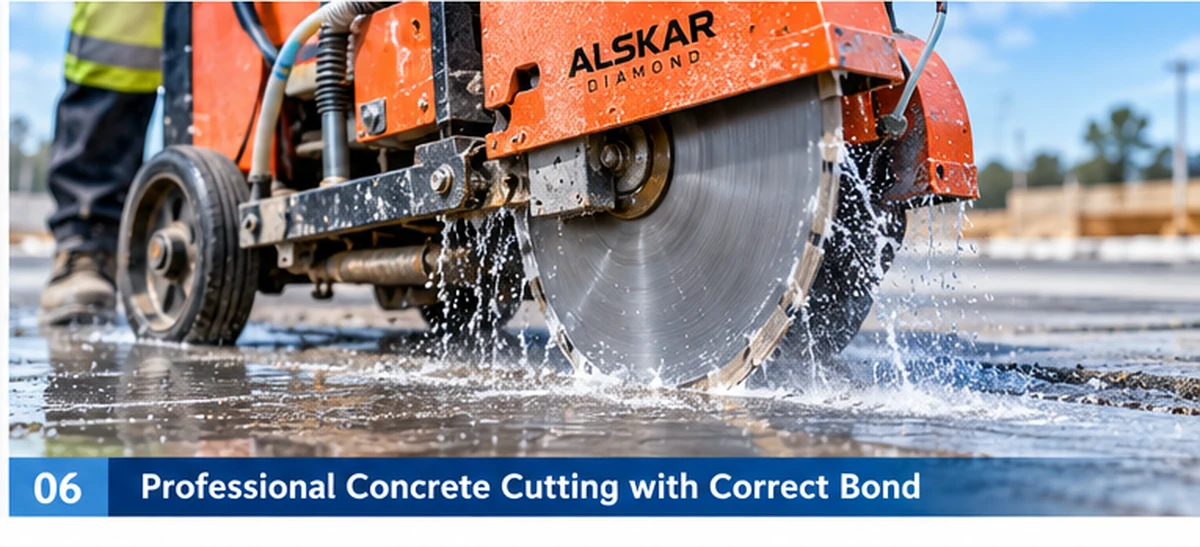
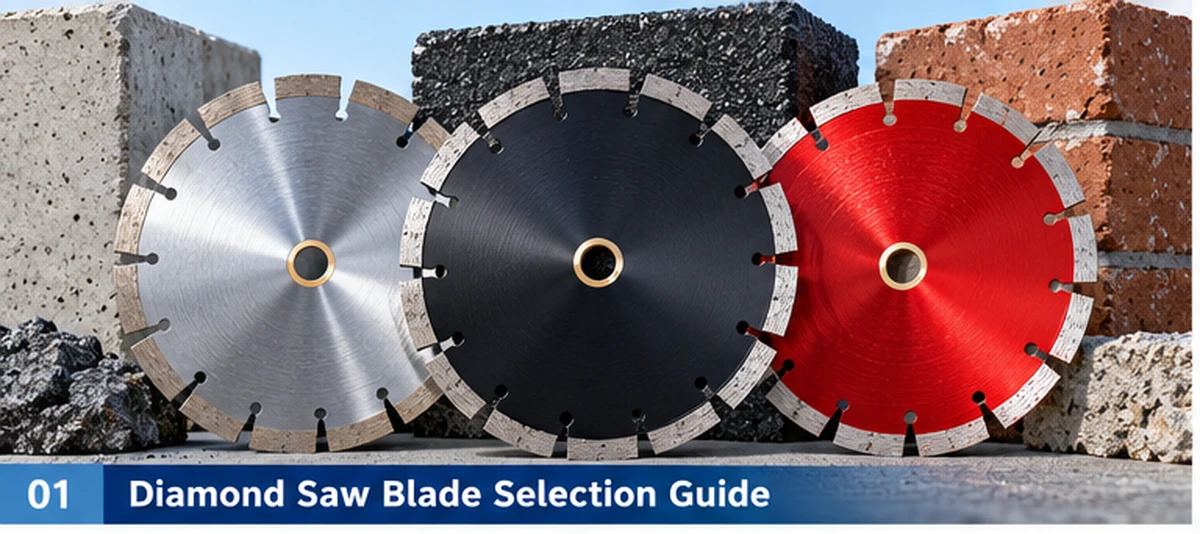
Professional concrete cutting demands more precise blade selection than choosing a generic “hard” or “soft” category.
ALSKAR DIAMOND offers professional concrete blade series intended for different saw horsepower ranges and cutting conditions.
ALSKAR Pro Concrete — Premium
The Premium Pro Concrete series is designed for wet cutting with suitable walk-behind saws rated up to 35 HP.
The series includes three bond selections:
| ALSKAR Bond Code | Intended Material Category |
|---|---|
| P01 | Hard concrete |
| P02 | Medium-hard concrete |
| P03 | Standard cured concrete |
These descriptions refer to intended cutting applications, not a published laboratory hardness rating of the metal matrix.
The correct selection depends on actual aggregate and concrete characteristics.
ALSKAR Pro Concrete — Supreme
The Supreme Pro Concrete series is intended for wet cutting with suitable higher-powered walk-behind saws in the 35–65 HP range.
Its five bond options cover a broader range of concrete conditions:
- Very hard concrete
- Medium-hard concrete
- Standard concrete
- Soft concrete
- Very soft concrete
The exact bond designation should be selected from the current ALSKAR Supreme product specification.
A wider selection of bonds allows contractors to match blade wear characteristics more closely to the cutting application.
Choosing Between Premium and Supreme
The decision should consider both the machine and the material.
Premium and Supreme are not interchangeable solely based on bond labels.
Saw horsepower, blade diameter, segment design, wet-cutting requirements, and intended concrete conditions all matter.
Always verify the blade’s published RPM rating, arbor specification, saw compatibility, and permitted cutting method before installation.
8. How to Select the Correct Bond for a Concrete Cutting Job
Use the following practical selection process.
Step 1: Identify the material.
Determine whether you are cutting cured concrete, reinforced concrete, green concrete, asphalt, or another approved material.
Step 2: Evaluate aggregate characteristics.
Identify whether the aggregate is relatively hard, medium, or soft, and consider how abrasive the concrete is likely to be.
Step 3: Check the saw.
Confirm saw type, horsepower, blade diameter, arbor, spindle speed, and operating method.
Step 4: Identify cutting conditions.
Determine whether the application requires wet cutting, the anticipated cut depth, and whether the blade will encounter steel reinforcement.
Step 5: Select a matching blade series and bond.
Use the manufacturer’s recommended application range rather than choosing a bond based solely on a generic hardness description.
Step 6: Evaluate performance safely.
Monitor cutting productivity, segment wear, cooling, and any abnormal operating symptoms. Stop and inspect the blade if performance deteriorates or unsafe conditions develop.
For large projects, evaluating cutting productivity alongside usable blade life can help determine the most economical blade selection.
9. Is a Harder Bond Always More Durable?
Not necessarily.
A harder bond generally provides greater resistance to matrix wear under comparable conditions, but that does not automatically mean better overall blade performance.
If the bond fails to expose diamonds effectively, cutting productivity can decline even while substantial segment material remains.
Likewise, a softer bond may deliver better performance and acceptable blade life when used on hard concrete for which it is correctly designed.
The appropriate metric is not simply how much segment remains after cutting.
Contractors should consider:
- Cutting speed
- Consistency of performance
- Usable segment life
- Cutting productivity
- Blade cost
- Labor and equipment time
- Total cost per cut or per linear foot
The right bond balances cutting efficiency with service life under actual jobsite conditions.
10. Final Diamond Blade Bond Selection Checklist
Before choosing a diamond blade bond, review the following:
- Material type and curing condition
- Aggregate hardness and abrasiveness
- Concrete mix characteristics
- Presence of reinforcement
- Saw type and horsepower
- Blade diameter, arbor, and rated RPM
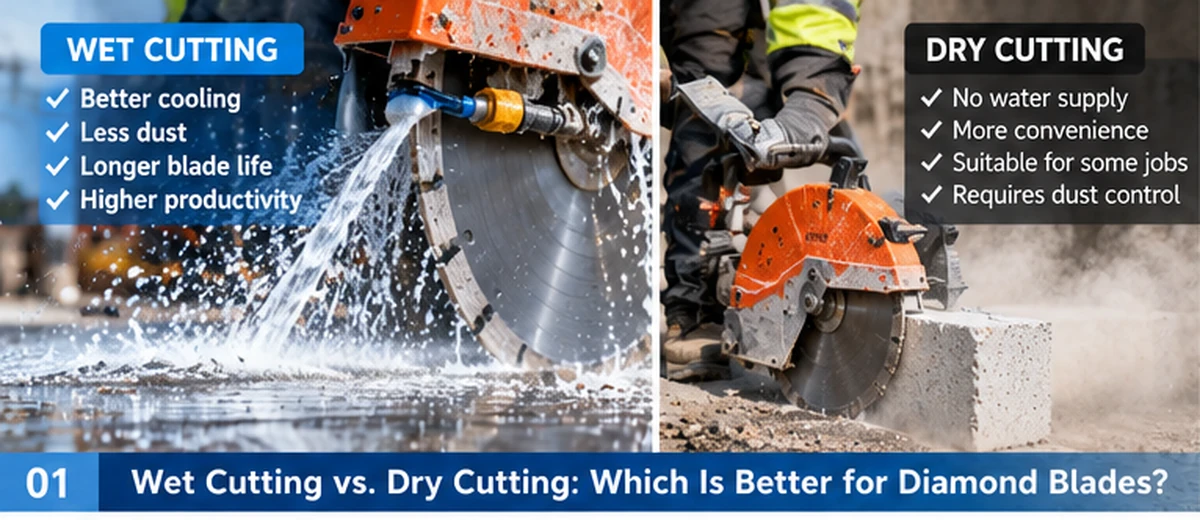
- Wet or dry cutting requirements
- Expected cutting volume
- Manufacturer-approved bond selection
- Cutting performance and overall project economics
The most effective diamond blade bond is not necessarily the hardest or softest. It is the one engineered for the cutting material and operating conditions.
Frequently Asked Questions
What does bond hardness mean in a diamond blade?
Bond hardness describes the wear behavior of the matrix that holds diamond particles. It affects how worn diamonds are released and new cutting points become exposed.
Should I use a hard bond or soft bond for hard concrete?
Hard, relatively less-abrasive concrete often benefits from a softer bond. The final selection also depends on aggregate abrasiveness, saw specifications, and cutting conditions.
Why do asphalt blades usually have harder bonds?
Asphalt can cause rapid segment wear. A more abrasion-resistant bond helps control matrix consumption and improve usable blade life.
What happens if a diamond blade bond is too hard?
The matrix may wear too slowly, preventing effective diamond exposure. This can cause glazing and reduced cutting performance.
What happens if a diamond blade bond is too soft?
The matrix may wear too quickly, resulting in excessive segment consumption and shortened blade life.
Does concrete PSI determine the correct bond?
No. Aggregate hardness, material abrasiveness, curing conditions, and saw characteristics must also be considered.
Can I use the same bond for concrete and asphalt?
Only when the blade is specifically designed and approved for both materials. Specialized blades are often better for sustained cutting in one material.
Can a glazed diamond blade be restored?
Some blades may be dressed using a manufacturer-approved method. Inspect the blade first and never attempt to restore a structurally damaged blade.
Explore ALSKAR DIAMOND Professional Concrete Blades
ALSKAR DIAMOND offers concrete-cutting blade options for different aggregates, saw horsepower ranges, and professional applications.
For assistance selecting a blade, provide the concrete type, aggregate information, saw model, horsepower, blade size, arbor requirements, and cutting conditions.
Explore ALSKAR Diamond Saw Blades or contact our team for application-specific recommendations.
Technical disclaimer: This article is intended for general blade-selection education. Always follow the product manufacturer’s instructions, equipment operating limits, and applicable jobsite safety requirements. When cutting silica-containing materials, comply with applicable OSHA exposure-control requirements.