How to Choose the Right Diamond Core Bit for Concrete and Masonry

How to Choose the Right Diamond Core Bit for Concrete and Masonry
A Professional Guide to Wet and Dry Core Drilling, Reinforced Concrete, Masonry Applications, Core Bit Sizes and Drill Compatibility
Choosing the right diamond core bit is essential for efficient, accurate drilling in concrete, brick, concrete block, and other masonry materials.
Whether you are drilling openings for plumbing, HVAC systems, electrical installations, or construction services, the correct core bit can make a significant difference in drilling productivity and tool life.
However, not all diamond core bits are designed for the same materials.
A dry core bit intended for soft brick and concrete masonry units (CMU) should not automatically be used for drilling solid concrete. Similarly, a wet core bit designed for ordinary concrete is not necessarily suitable for heavy reinforcement.
Professional contractors should evaluate the material, reinforcement, drilling diameter, required depth, connection thread, drilling equipment, and operating method before choosing a core bit.
In this guide, ALSKAR DIAMOND explains the key considerations for selecting the right diamond core bit for concrete and masonry applications.
1. What Is a Diamond Core Bit?
A diamond core bit is a cylindrical drilling tool designed to remove material around the circumference of a hole.
Unlike a conventional drill bit that removes most of the material inside the hole, a core bit cuts an annular opening and produces a cylindrical core.
The cutting end contains diamond-bearing segments or a cutting rim.
These diamonds abrade the material while the surrounding bond gradually wears to expose fresh cutting points.
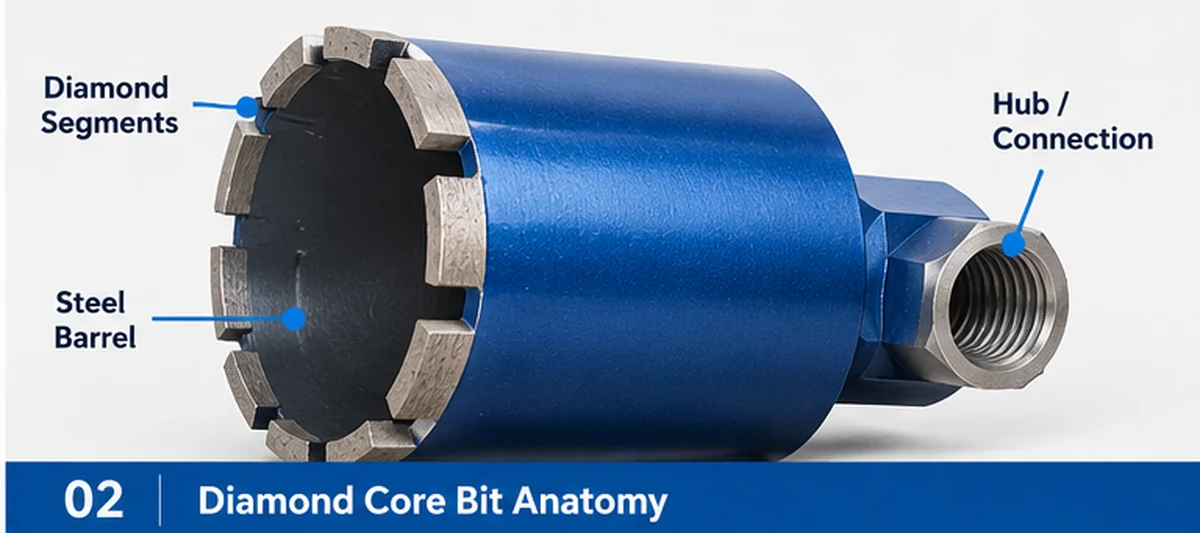
The main components of a typical segmented diamond core bit include:
- Diamond Segments: The abrasive cutting elements at the end of the barrel.
- Steel Barrel: The cylindrical body that supports the cutting segments.
- Hub or Connection: The interface connecting the bit to the drilling machine.
- Segment Attachment: The method used to secure cutting segments to the barrel.
- Effective Drilling Depth: The usable drilling depth specified for the bit.
Diamond core bits are widely used for creating accurately sized openings in concrete and masonry without requiring the entire hole area to be mechanically broken apart.
2. Identify the Material Before Choosing a Core Bit
The first step is to identify the material you need to drill.
Different materials create different levels of cutting resistance and abrasion.
Cured Concrete
Cured concrete contains hardened cement paste and mineral aggregates.
Its drilling behavior depends on aggregate hardness, abrasiveness, concrete condition, and the presence of reinforcement.
For demanding cured concrete applications, a concrete-rated wet diamond core bit is often appropriate.
The metal bond should be matched to the material to maintain efficient diamond exposure.
Reinforced Concrete
Reinforced concrete contains steel bars or other reinforcement.
When drilling through reinforced concrete, the core bit may encounter both hard mineral aggregates and steel.
This creates additional demands on the diamond segments, segment attachment, machine stability, and drilling technique.
Use a diamond core bit specifically approved for reinforced concrete.
ALSKAR DIAMOND’s Premium Laser-Welded Wet Core Bit series is an option for concrete drilling applications involving rebar, subject to the specifications of the selected size and compatible equipment.
Concrete Masonry Units (CMU)
Concrete masonry units are often used in walls, partitions, and commercial construction.
Many conventional concrete blocks are relatively soft and abrasive.
Dedicated dry masonry core bits may be suitable for these materials.
However, CMU construction varies. Fully grouted or steel-reinforced block walls may require a different drilling method and core bit specification.
Soft Clay Brick and Soft Masonry
Soft brick and similar masonry materials can often be drilled using application-approved dry diamond core bits.
Dry masonry core bits provide a convenient option when water delivery is impractical, provided the equipment and dust-control arrangements are appropriate.
Do not assume a dry masonry core bit can drill hard structural concrete simply because both materials contain mineral aggregates.
Quick Material Selection Table
| Material | General Core Bit Recommendation | Important Consideration |
|---|---|---|
| Cured solid concrete | Concrete-rated wet core bit | Aggregate, bond and equipment compatibility |
| Reinforced concrete | Rebar-rated wet core bit | Steel reinforcement and segment attachment |
| Ordinary hollow CMU | Dry masonry or approved wet bit | Block hardness and abrasiveness |
| Soft clay brick | Dry masonry or approved wet bit | Material-specific application rating |
| Soft masonry | Application-approved masonry bit | Abrasiveness and cutting conditions |
| Fully grouted reinforced CMU | Reinforcement-rated bit if required | Grout, steel and wall construction |
| Hard stone or dense masonry | Specialized application-rated core bit | Material hardness and bit formulation |
The manufacturer’s approved application range always takes priority over general material classifications.
3. Wet vs. Dry Diamond Core Drilling
One of the most important choices is whether to use a wet or dry diamond core bit.
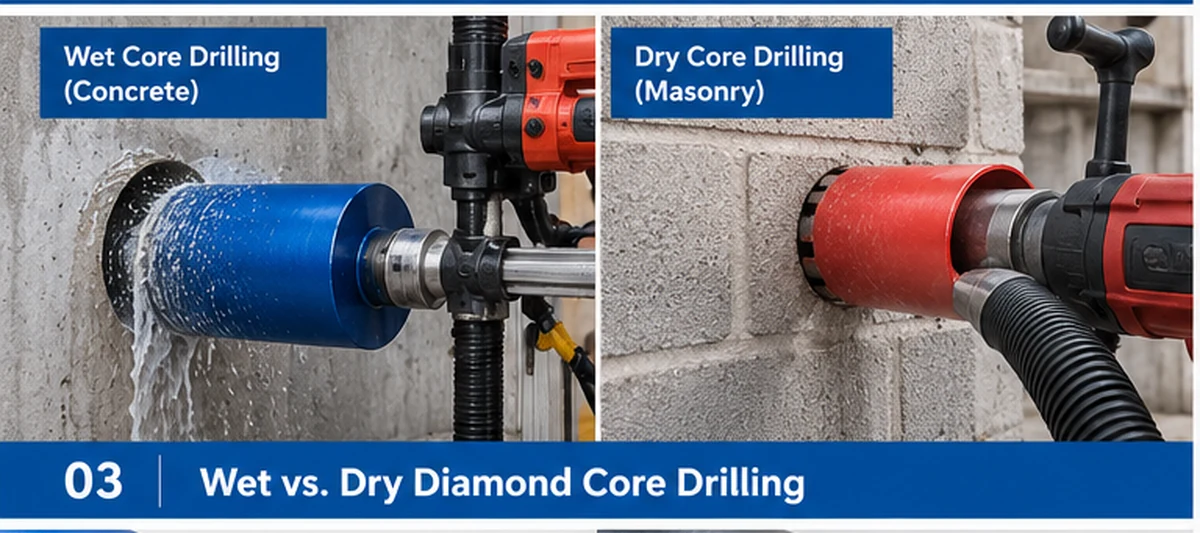
Wet Diamond Core Drilling
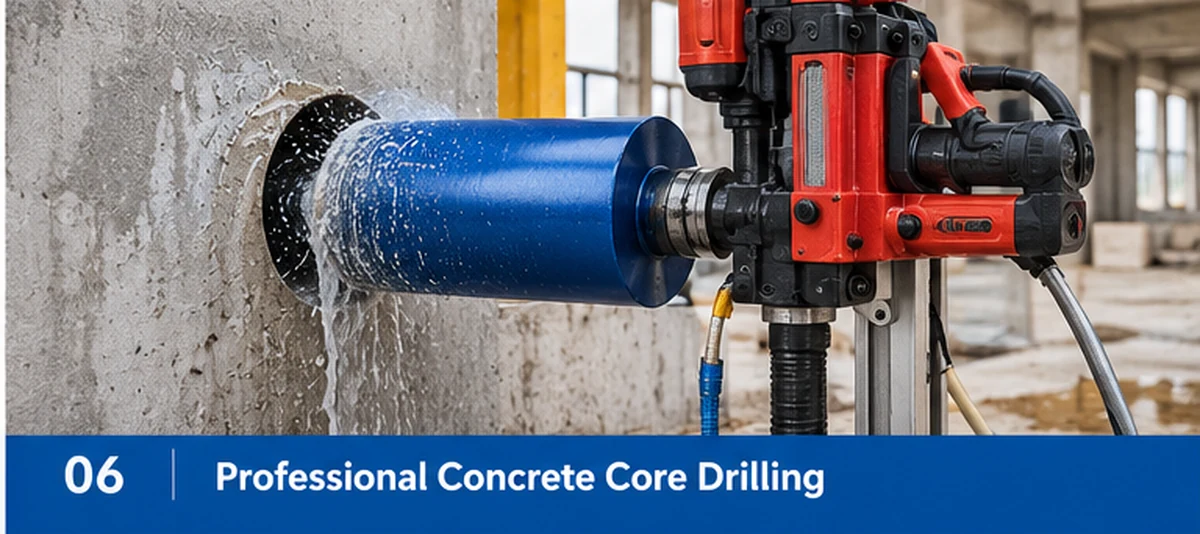
Wet core drilling uses a controlled water supply at the cutting interface.
Water helps cool the segments, carry away drilling debris, and reduce airborne dust generation.
Wet drilling is commonly used for concrete and reinforced concrete.
It is particularly useful for demanding drilling operations with compatible drilling equipment.
However, water supply, slurry management, and site conditions must be considered.
Dry Diamond Core Drilling
Dry core drilling uses a core bit specifically designed for approved drilling applications without continuous water cooling.
Dry drilling can be convenient for soft brick, ordinary CMU, and certain masonry applications.
The allowable drilling conditions depend on the bit, machine, and material.
Dry drilling does not eliminate the need for silica dust control.
Appropriate engineering controls, drilling procedures, and workplace safety measures remain necessary.
Wet vs. Dry Core Bit Comparison
| Feature | Wet Core Bits | Dry Core Bits |
|---|---|---|
| Cooling | Water-assisted | Application-specific dry operation |
| Typical applications | Concrete and approved reinforced concrete | Soft brick, CMU and compatible masonry |
| Debris removal | Water carries away slurry | Slots and approved dust extraction arrangements |
| Water supply | Required for wet-only bits | Not required for bit cooling |
| Common drilling setup | Compatible wet core drilling machine | Compatible dry drilling machine |
| Main consideration | Water and slurry management | Heat and silica dust management |
A dry-rated core bit should not be used beyond its published material and operating limits.
To understand how cooling affects diamond cutting tools, read our Wet Cutting vs. Dry Cutting Guide: https://alskardiamond.com/wet-vs-dry-diamond-blade-cutting/
4. Understanding Diamond Core Bit Segment Construction
Segment attachment and segment design are important elements of core bit performance.
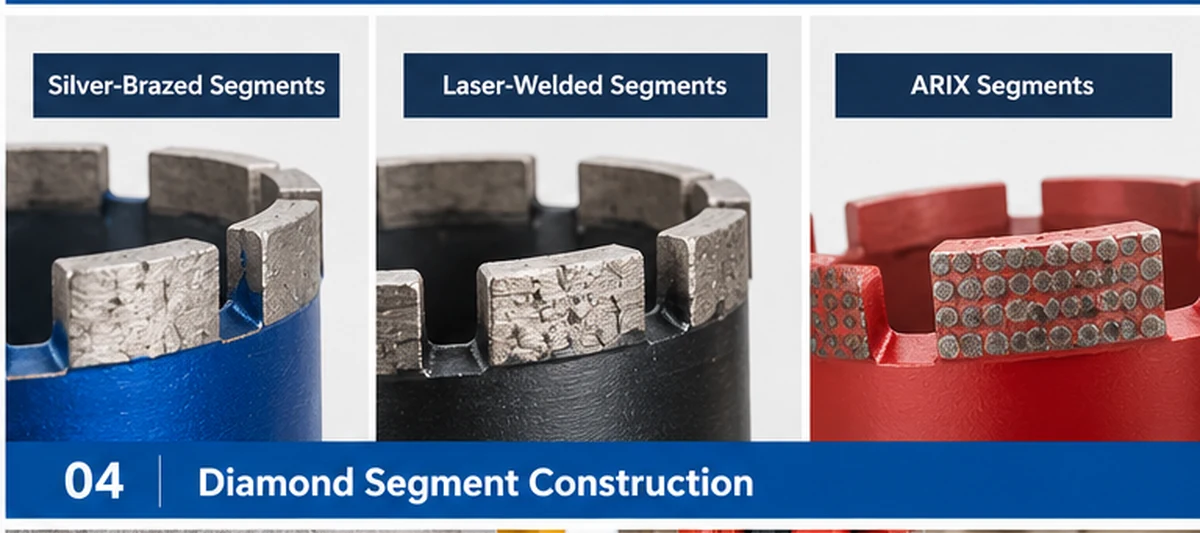
Silver-Brazed Diamond Segments
Silver brazing uses a brazing alloy to attach the diamond segments to the steel barrel.
It is commonly used on wet core bit constructions.
Brazed attachments have operating-temperature limitations and must be used according to the manufacturer’s instructions.
For ALSKAR DIAMOND, the Premium Wet Core Bit series uses silver-brazed segments and is intended for wet drilling.
Do not use a wet-only brazed core bit without the required water supply.
Laser-Welded Diamond Segments
Laser welding attaches cutting segments to the barrel using a localized welding process.
This construction is used on various professional core bits, including models intended for demanding concrete applications.
However, laser welding alone does not establish that a bit is rated for dry drilling or reinforced concrete.
The application rating of the complete core bit remains the deciding factor.
ALSKAR’s Premium Laser-Welded Wet Core Bit series is designed for wet concrete drilling and includes an approved reinforced-concrete application.
ARIX Diamond Segments
ARIX-style segments use an engineered arrangement of diamond particles within the segment.
The controlled diamond distribution is intended to support consistent cutting-point exposure and cutting performance.
Nevertheless, ARIX construction does not automatically make a core bit suitable for every material.
ALSKAR’s Supreme ARIX Dry Masonry Core Bits are intended for soft brick, concrete block (CMU), and soft masonry.
They are not intended for solid concrete or reinforced concrete.
Segment Construction Comparison
| Construction | ALSKAR Product Example | Approved Application Direction |
|---|---|---|
| Silver-brazed segments | Premium Wet Core Bits | Wet drilling in compatible concrete/masonry |
| Laser-welded segments | Premium Laser-Welded Wet Core Bits | Wet concrete drilling, including approved rebar applications |
| ARIX segments | Supreme Dry Masonry Core Bits | Dry drilling in soft brick, CMU and soft masonry |
Actual drilling performance also depends on segment bond, diameter, drilling conditions, and machine compatibility.
Learn more about how metal bond wear affects diamond exposure in our Hard Bond vs. Soft Bond Diamond Blade Guide: https://alskardiamond.com/diamond-blade-hard-bond-vs-soft-bond/
5. Choose the Correct Core Bit Diameter
Diamond core bit diameter determines the nominal size of the opening.
Common applications include:
- Plumbing pipe penetrations
- HVAC openings
- Electrical conduit penetrations
- Mechanical service installations
- Utility access holes
- Structural and construction-related coring
Select the diameter according to the project requirement.
Allow for any specified clearance needed for sleeves, pipe insulation, firestop systems, or other installation components.
Do not assume the outside diameter of a pipe matches the required drilled hole size.
ALSKAR Core Bit Diameter Ranges
| ALSKAR Series | Available Diameter Range |
|---|---|
| Premium Wet Core Bits | 1″–14″ |
| Premium Laser-Welded Wet Core Bits | 1″–16″ |
| Supreme ARIX Dry Core Bits | 2″–6″ |
| Supreme Dry Masonry Core Bits | 1″–6″ |
Always confirm the availability and technical specifications of the exact product variation before ordering.
Larger diameter bits generally require greater attention to drill capacity, torque, stand stability, and mounting arrangements.
6. Understand Barrel Length vs. Effective Drilling Depth
A core bit’s overall length or barrel length is not necessarily the same as its effective drilling depth.
This distinction is important when drilling through thick walls, slabs, and foundations.
Barrel Length
Barrel length describes the length of the cylindrical barrel.
It does not automatically represent the complete usable drilling depth.
Effective Drilling Depth
Effective drilling depth is the usable depth stated for the core bit under its specified configuration.
For example, the ALSKAR Premium Wet Core Bit series uses an 18-inch barrel with a specified effective drilling depth of 14 inches.
The Premium Laser-Welded Wet Core Bit series has an overall length of 16 inches and an effective drilling depth of 14 inches.
For ALSKAR’s dry masonry range, the specified 9-inch barrel or effective depth should be checked against the exact selected product.
ALSKAR Length Comparison
| Core Bit Series | Barrel / Overall Length | Effective Drilling Depth |
|---|---|---|
| Premium Wet Core | 18″ barrel | 14″ |
| Premium Laser-Welded Wet Core | 16″ overall | 14″ |
| Supreme ARIX Dry Core | 9″ barrel | Verify selected variation |
| Supreme Dry Masonry Core | 9″ barrel | 9″ |
If the project requires deeper drilling, confirm the correct extension system, core removal procedure, and drill compatibility.
Do not assume that adding an extension automatically provides unrestricted drilling depth.
7. Check Core Bit Thread and Machine Compatibility
Selecting the correct connection is essential.
A core bit must match the drilling machine’s spindle or an explicitly approved adapter system.
Common U.S. diamond core drilling connections include 5/8″-11 and 1-1/4″-7, but other manufacturers and international markets use additional systems.
The thread’s nominal diameter alone does not establish compatibility.
Thread pitch, connection gender, hub geometry, adapter specification, and machine requirements must all match.
ALSKAR Core Bit Connection Overview
| Core Bit Series | Known Connection Information |
|---|---|
| Premium Wet Core, 1″ and 1.5″ | 5/8″-11 |
| Premium Wet Core, 2″ and larger | 1-1/4″-7 |
| Premium Laser-Welded Wet, 1″ and 1.5″ | 5/8″-11 |
| Premium Laser-Welded Wet, 2″ and larger | 1-1/4″-7 |
| Supreme ARIX Dry Core, 2″–6″ | 5/8″-11 |
| Supreme Dry Masonry Core, 1″–6″ | 5/8″-11 |

Before purchasing, verify:
- Drill make and model.
- Spindle connection.
- Core bit connection specification.
- Required adapter, if any.
- Drill’s approved diameter capacity.
- Machine operating speed and torque requirements.
- Wet or dry drilling compatibility.
Do not use improvised thread adapters or incompatible mounting components.
8. Choose the Correct Drilling Machine
Core bit selection must account for the machine.
Handheld Core Drills
Handheld core drilling systems are used for approved applications and diameter ranges.
The machine manufacturer determines the permissible drilling capacity and operating method.
Large-diameter or demanding reinforced-concrete coring may exceed the appropriate capacity of a handheld machine.
Stand-Mounted Core Drills
Stand-mounted systems provide controlled drilling alignment and support for many professional concrete coring operations.
They are widely used for larger diameters and demanding applications.
The stand must be secured in accordance with the equipment manufacturer’s requirements.
RPM and Torque
Different core bit diameters and materials require suitable machine operating conditions.
A larger core bit does not necessarily use the same operating speed as a smaller diameter.
Always consult the drill manufacturer’s recommended speed range and the core bit’s published operating limits.
Do not assign a universal RPM to all diamond core bits.
Drilling Technique
Use steady, controlled drilling pressure and follow the machine manufacturer’s operating instructions.
Do not use hammer or percussion mode unless the complete diamond coring system explicitly permits it.
Stop and inspect the equipment if there is excessive vibration, abnormal noise, unstable operation, or loss of cutting performance.
9. Choosing the Right ALSKAR DIAMOND Core Bit
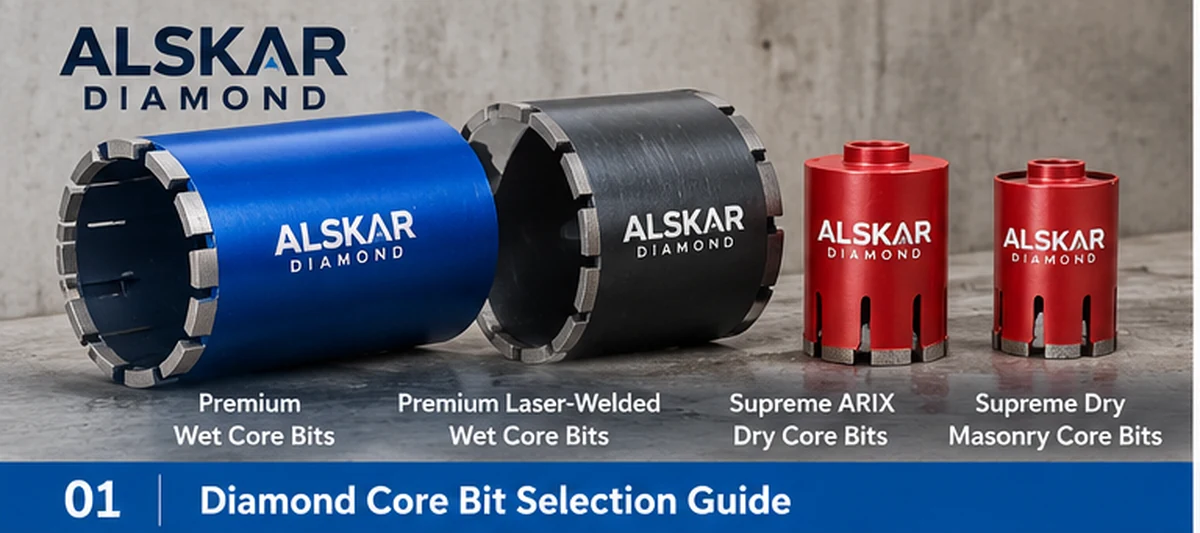
ALSKAR DIAMOND offers multiple core bit constructions for different drilling applications.
Premium Wet Core Bits
The Premium Wet Core Bit series is suitable for professional wet drilling in its approved materials.
Key published series characteristics include:
- Diameter range: 1″–14″
- Barrel length: 18″
- Effective drilling depth: 14″
- Diamond segment height: 10 mm
- Segment attachment: Silver brazed
- Connection: 5/8″-11 on selected smaller sizes and 1-1/4″-7 on larger sizes
Select this series based on the drilling material and the exact product’s approved application.
Do not assume that every size is suitable for steel reinforcement.
Premium Laser-Welded Wet Core Bits
This series is intended for demanding wet concrete drilling applications, including approved reinforced-concrete drilling.
Key specifications include:
- Diameter range: 1″–16″
- Overall length: 16″
- Effective drilling depth: 14″
- Diamond segment height: 10 mm
- Segment attachment: Laser welded
- Wet drilling operation
Select a compatible machine and confirm the relevant variation’s specifications.
Supreme ARIX Dry Core Bits
The Supreme ARIX Dry Core Bit series provides a dry drilling option for compatible soft masonry applications.
Key characteristics include:
- Diameter range: 2″–6″
- Barrel length: 9″
- Connection: 5/8″-11
- ARIX segment design
- Approved materials: Soft brick, concrete block (CMU), and soft masonry
Not recommended for solid concrete or reinforced concrete.
Supreme Dry Masonry Core Bits
The Supreme Dry Masonry Core Bit range is designed for soft brick, CMU, and other approved soft masonry.
Key specifications include:
- Diameter range: 1″–6″
- Barrel length: 9″
- Effective drilling depth: 9″
- Connection: 5/8″-11
- ARIX segment design
This series should not be selected for solid concrete or reinforced concrete.
10. Common Diamond Core Bit Selection Mistakes
Mistake 1: Using a Dry Masonry Bit on Solid Concrete
Dry masonry bits are not automatically suitable for dense structural concrete.
Using a bit outside its approved material range may cause glazing, overheating, rapid wear, or equipment problems.
Mistake 2: Ignoring Steel Reinforcement
A core bit intended for ordinary concrete may not be rated for cutting rebar.
Choose an application-approved reinforced-concrete bit where steel may be encountered.
Mistake 3: Confusing Barrel Length with Drilling Depth
A longer barrel does not always provide the same effective drilling depth.
Check the manufacturer’s specifications.
Mistake 4: Choosing the Wrong Connection
A bit that does not properly match the machine’s spindle or approved adapter may not mount safely.
Always confirm the complete connection specification.
Mistake 5: Ignoring Drill Capacity
Large-diameter coring can place significant loads on drilling equipment.
Use a machine rated for the bit diameter and material.
Mistake 6: Inadequate Cooling or Dust Control
Wet-only bits require the specified water delivery.
Dry drilling of silica-containing materials requires applicable exposure controls.
Mistake 7: Choosing Only by Purchase Price
The lowest purchase price does not always mean the lowest drilling cost.
Contractors should consider productivity, usable bit life, equipment time, and cost per completed hole.
11. Core Drilling Safety and Silica Dust Control
Concrete, brick, and masonry may contain crystalline silica.
Drilling these materials can generate respirable crystalline silica exposure.
In the United States, OSHA regulation 29 CFR 1926.1153 establishes requirements for controlling silica exposure in construction.
For rig-mounted core saws or drills using the prescribed Table 1 method, OSHA specifies an integrated water-delivery system that supplies water to the cutting surface.
The drilling system must be operated and maintained according to the manufacturer’s instructions.
Other drilling configurations may have different specified controls.
Employers should evaluate the actual equipment and task and use an applicable compliant exposure-control method.
Core drilling also requires attention to:
- Hidden utilities and embedded services
- Structural drilling restrictions
- Secure machine mounting
- Falling core hazards
- Water and electrical safety
- Slurry collection and cleanup
- Required personal protective equipment
- Equipment inspection and maintenance
Never drill into structural elements without appropriate project authorization or verification of the drilling location.
12. Final Diamond Core Bit Selection Checklist
Before ordering or using a diamond core bit, verify:
- The material being drilled.
- Presence and type of reinforcement.
- Required hole diameter.
- Required effective drilling depth.
- Wet or dry drilling requirements.
- Core bit segment construction and material rating.
- Machine power and approved diameter range.
- Connection thread and hub compatibility.
- Appropriate drilling speed and operating technique.
- Dust control, cooling, and jobsite safety requirements.
The best diamond core bit is not necessarily the one with the longest barrel or most advanced segment design. It is the bit correctly matched to the drilling material, machine, hole dimensions, and operating conditions.
Frequently Asked Questions
What diamond core bit should I use for concrete?
Choose a concrete-rated diamond core bit matched to the concrete condition, drilling diameter, required depth and drilling machine. Wet core bits are commonly used for professional concrete coring.
Can a dry diamond core bit drill concrete?
Only if the specific bit is rated for that application. ALSKAR Supreme dry masonry core bits are designed for soft brick, CMU and soft masonry, not solid concrete.
What core bit should I use for reinforced concrete?
Choose a core bit specifically approved for reinforced concrete. ALSKAR Premium Laser-Welded Wet Core Bits offer an option for approved applications involving rebar.
What is the difference between wet and dry core bits?
Wet core bits use water for cooling and debris removal. Dry core bits are designed for approved dry drilling applications and still require appropriate dust controls.
What is the difference between laser-welded and brazed core bits?
Laser welding and brazing are different methods of attaching segments to the barrel. The suitability of either method depends on the complete core bit design and published operating requirements.
Are ARIX core bits better than standard diamond core bits?
ARIX-style segments use engineered diamond distribution. Actual performance depends on the material, segment bond, drilling machine and operating conditions.
What does 5/8″-11 mean on a diamond core bit?
It indicates a nominal thread size and pitch. The complete connection, including thread geometry and mounting requirements, must match the drill.
What is the difference between 5/8″-11 and 1-1/4″-7 connections?
They are different thread standards and cannot be directly interchanged. Use the correct connection or an approved adapter.
How deep can a diamond core bit drill?
Drilling depth depends on the bit’s effective drilling depth, not just barrel length. ALSKAR Premium Wet and Premium Laser-Welded Wet series both specify a 14-inch effective drilling depth.
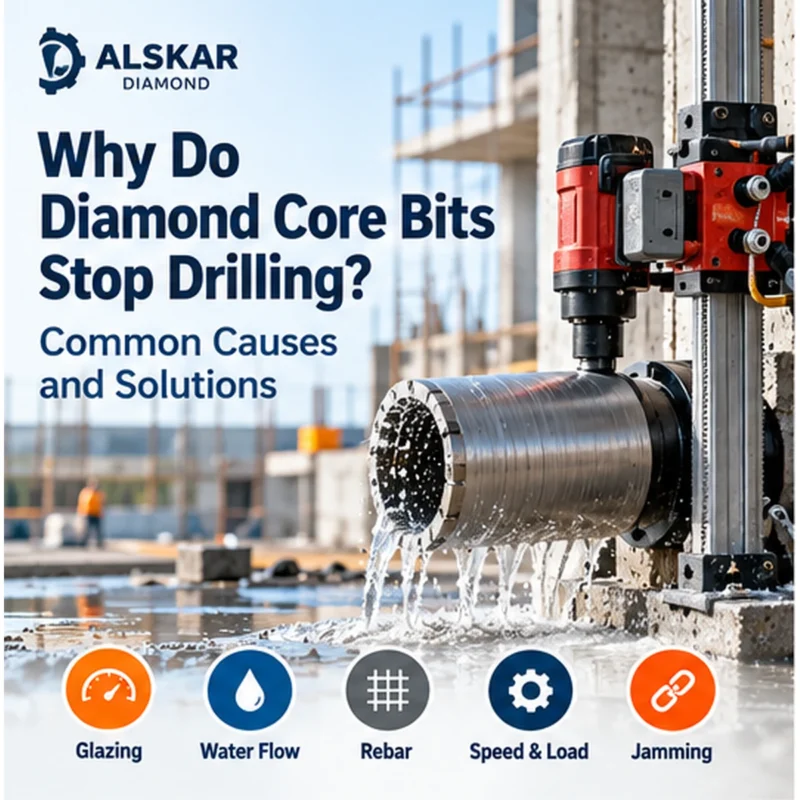
Why does my diamond core bit stop drilling?
Possible causes include glazing, incorrect bond selection, inadequate cooling, machine speed or power mismatch, and drilling material outside the bit’s approved application range.
Explore ALSKAR DIAMOND Core Bits
ALSKAR DIAMOND offers professional diamond core bits for concrete and compatible masonry applications.
Explore our wet core bits, laser-welded concrete core bits, and dry masonry core bits to find a product suited to your drilling project.
For assistance selecting the correct core bit, contact ALSKAR DIAMOND with your drilling material, hole diameter, required depth, machine model, spindle connection, and reinforcement conditions.
Technical note: This guide provides general product-selection information. Always follow the exact product specifications, drilling equipment instructions, and applicable workplace safety requirements.