PCD vs. Diamond Grinding Shoes: What’s the Difference?


PCD vs. Diamond Grinding Shoes: What’s the Difference?
A Professional Guide to Coating Removal, Concrete Floor Grinding, Surface Preparation, and Tool Selection
When preparing a concrete floor for a new coating, polishing system, or surface treatment, choosing the right grinding tool can significantly affect productivity and surface quality.
Two common tooling options are PCD coating removal shoes and metal-bond diamond grinding shoes.
Although both are used on concrete floor grinding equipment, they are designed for different primary applications.
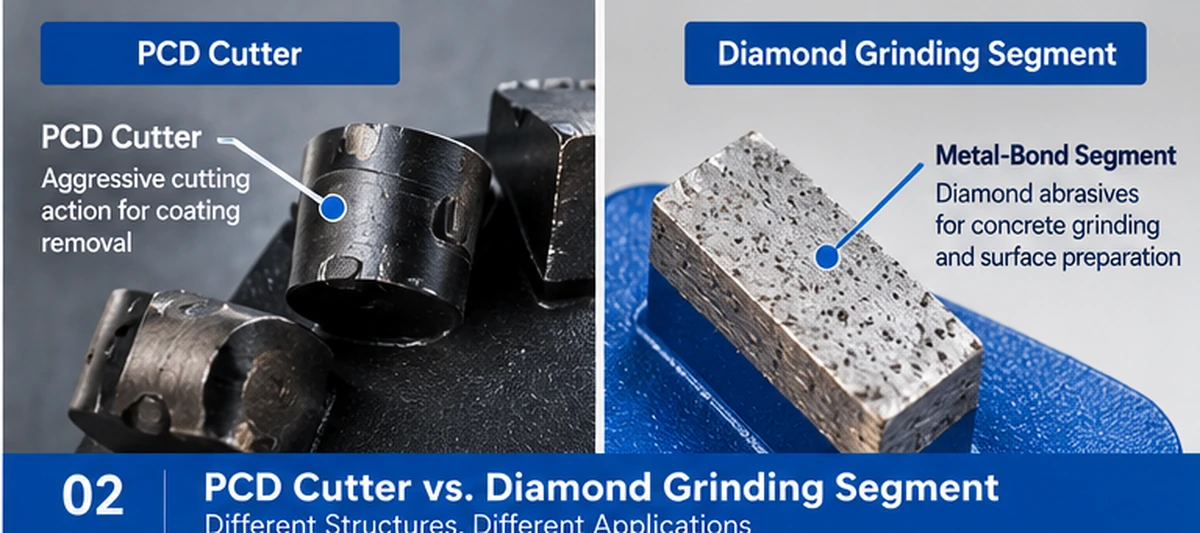
PCD tools are typically selected to remove coatings and surface materials through an aggressive cutting or scraping action.
Conventional metal-bond diamond grinding shoes are commonly used to abrade concrete, remove surface irregularities, and prepare the substrate for subsequent treatment.
Using the wrong tool may result in slow production, excessive wear, clogging, or an unsuitable surface finish.
In this guide, ALSKAR DIAMOND explains the differences between PCD and diamond grinding shoes, their applications, and how professional contractors can choose the appropriate tooling.
1. What Are PCD Coating Removal Shoes?
PCD stands for Polycrystalline Diamond.
PCD is a superhard material made from bonded diamond crystals. In floor preparation tools, PCD cutting elements are positioned to mechanically remove compatible coatings and surface materials.
Unlike conventional abrasive grinding segments, PCD cutters typically work through an aggressive scraping, shearing, or cutting action.
This makes them useful for removing certain surface coverings that can be difficult to process efficiently with ordinary diamond grinding segments.
Common PCD Applications
Depending on the tool design and coating characteristics, PCD shoes may be used for:
- Epoxy coating removal
- Paint removal
- Adhesive and glue residue removal
- Certain polyurethane and other resin-based coatings
- Selected mastic removal applications
- Removal of compatible floor coverings and surface buildup
Actual performance depends on coating thickness, hardness, adhesion, temperature, substrate condition, and the PCD cutter arrangement.
PCD tools should not be assumed suitable for every coating or adhesive.
For older flooring and unknown materials, evaluate possible hazardous constituents before mechanical removal.
How Do PCD Shoes Work?
PCD cutters engage the coating and remove it mechanically.
The objective is generally to remove unwanted material from the floor surface while minimizing unnecessary grinding of the underlying concrete.
However, aggressive PCD tools can scratch or gouge the concrete if the tool, machine, or operating conditions are unsuitable.
Tool selection must therefore consider both removal productivity and the required condition of the remaining substrate.
2. What Are Diamond Grinding Shoes?
Diamond grinding shoes use industrial diamond particles held within a grinding segment, commonly a metal-bond matrix.
As the tool abrades concrete, the diamond particles remove material while controlled wear of the surrounding bond helps expose fresh cutting points.
Unlike PCD coating removal tools, conventional metal-bond diamond grinding shoes are primarily used for working the concrete substrate itself.
Common Diamond Grinding Applications
Diamond grinding shoes may be used for:
- Concrete surface preparation
- Removing surface irregularities
- Grinding high spots
- Leveling minor variations
- Removing certain surface residues
- Preparing a substrate for coatings
- Initial stages of concrete polishing systems
Tool performance depends on the abrasive specification, bond, segment design, machine setup, and concrete characteristics.
Diamond Grit Selection
Coarser diamond tools are generally used for more aggressive material removal.
Finer tools may be used as the surface preparation or finishing process progresses.
However, grit numbers are not universal indicators of the final surface profile.
When preparing a floor for a coating system, follow the coating manufacturer’s required surface profile rather than selecting tooling based solely on grit number.
3. PCD vs. Diamond Grinding Shoes: Key Differences
| Feature | PCD Coating Removal Shoes | Metal-Bond Diamond Grinding Shoes |
|---|---|---|
| Main purpose | Removing compatible coatings and surface buildup | Grinding and preparing concrete surfaces |
| Cutting action | Scraping, shearing and aggressive cutting | Abrasive grinding |
| Common applications | Epoxy, paint, compatible adhesives, selected mastics | Concrete preparation, leveling and initial polishing |
| Action on concrete | May scratch or gouge the substrate | Intended to abrade the concrete |
| Surface finish | May leave scratches, grooves or residual coating | Can provide a more controlled ground surface |
| Risk of clogging on sticky coatings | Often lower for suitable PCD designs | Can be higher with certain adhesives and coatings |
| Main selection factor | Coating characteristics and removal requirements | Concrete hardness, bond, grit and target profile |
| Typical workflow | Initial coating removal | Follow-up grinding and surface preparation |
PCD and diamond grinding shoes are complementary tools rather than direct substitutes.
In many projects, both may be needed to produce a properly prepared concrete surface.
4. When Should You Use PCD Coating Removal Shoes?
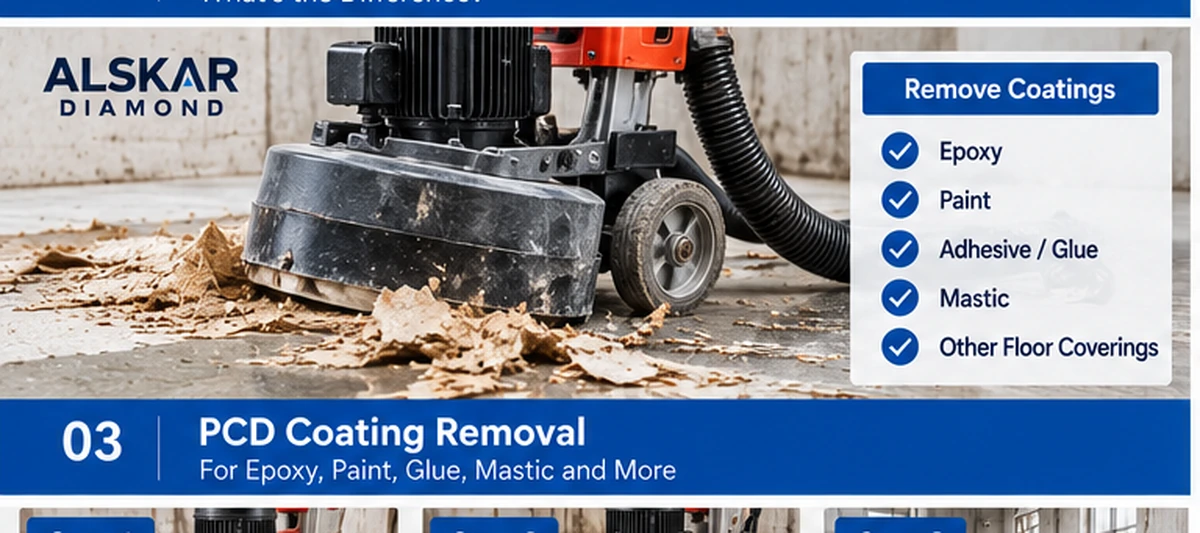
PCD tooling is often appropriate when the primary objective is removing an existing surface covering rather than grinding the concrete itself.
Epoxy Coating Removal
Certain epoxy coatings can be efficiently removed with appropriately designed PCD tooling.
However, not all epoxy systems behave the same way.
Thin coatings, thick epoxy mortar, highly flexible materials, and heavily bonded resin systems may require different cutters or preparation methods.
For demanding coating removal, always evaluate the coating and machine compatibility before selecting a PCD design.
Paint and Floor Coating Removal
PCD tools can be useful for removing some paints and resin-based coatings.
The appropriate tool depends on coating adhesion, flexibility, thickness and the required condition of the underlying concrete.
Adhesive and Glue Removal
Certain adhesives may soften or become tacky during grinding.
Conventional diamond grinding segments can sometimes become clogged by these materials.
An appropriate PCD tool can help mechanically remove compatible residues.
However, some adhesives may smear rather than fracture or separate cleanly.
A small test area is recommended when the coating composition is uncertain.
Mastic Removal
Some mastics can be removed with compatible PCD tooling.
Before disturbing older flooring or mastic, assess possible asbestos or other hazardous materials and follow applicable testing and abatement requirements.
Do not mechanically grind unidentified potentially hazardous material.
5. When Should You Use Diamond Grinding Shoes?
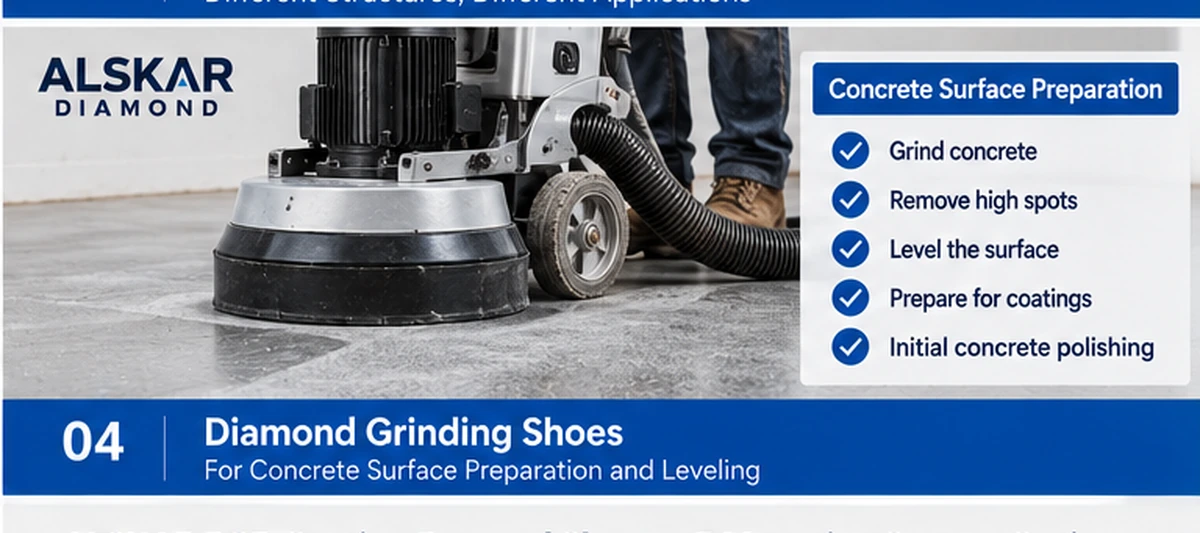
Diamond grinding shoes are generally preferred when the main task involves preparing or modifying the concrete substrate.
Concrete Surface Preparation
Grinding may be required to remove weak surface material, improve flatness and establish a suitable substrate for a coating or overlay.
The correct tooling depends on the concrete condition and the surface preparation requirement.
Removing High Spots
Appropriate diamond grinding tools can be used to reduce minor high spots and irregularities.
The grinding method must be suitable for the floor and structural conditions.
Surface Profiling
Many coating systems require a specified Concrete Surface Profile, commonly referenced using ICRI CSP classifications.
Grinding equipment and tooling should be selected to achieve the project specification.
The final profile should be verified according to the coating manufacturer’s requirements and applicable project standards.
Initial Concrete Polishing
Metal-bond diamond tooling is commonly used in the early stages of certain concrete polishing workflows.
Subsequent steps may use different abrasive systems to refine the surface.
PCD coating removal shoes are not a substitute for a complete concrete polishing sequence.
6. Why Diamond Grinding Shoes Can Clog on Coatings
Conventional metal-bond grinding segments are designed to abrade mineral surfaces.
When working against certain sticky or heat-sensitive coatings, removed material may adhere to the segments.
This can reduce cutting efficiency and cause excessive friction.
Potential symptoms include:
- Reduced removal rate
- Coating residue buildup on the segments
- Increased friction or heat
- Smearing of the coating
- Uneven cutting performance
PCD cutters may be more effective because they can separate compatible coatings mechanically instead of relying primarily on abrasive grinding.
However, PCD performance is not universal.
Very thin, brittle, hard or unusual coating systems may respond better to different tool designs.
The best tooling choice should be based on the actual coating and substrate—not just the coating’s general name.
7. Can PCD Shoes Damage Concrete?
Yes.
PCD tools are often aggressive.
Their cutting elements may leave scratches, grooves or local gouges in the underlying concrete.
The risk depends on:
- PCD cutter configuration
- Tool orientation
- Machine design
- Operating speed and load
- Coating thickness
- Concrete surface condition
- Operator technique
Some tooling configurations combine PCD cutters with abrasive segments to moderate cutting action or begin surface refinement.
However, this combination should not be assumed for every PCD product.
Where surface preservation is important, test a small area before full-scale removal.
After coating removal, diamond grinding may be necessary to refine the substrate to the specified profile.
8. Recommended Workflow: PCD Removal Followed by Diamond Grinding
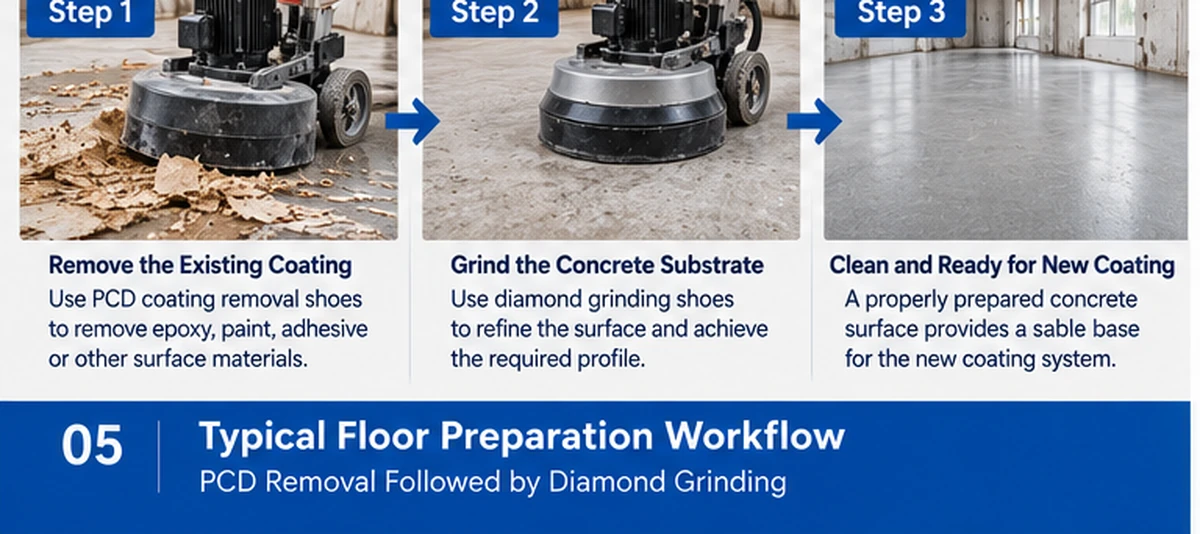
For many concrete floor renovation projects, a practical workflow involves separate removal and surface preparation stages.
Step 1 — Identify the Existing Material
Determine whether the floor contains epoxy, paint, glue, mastic, or another coating.
Assess the coating thickness, adhesion and possible hazardous substances.
Step 2 — Select Compatible Coating Removal Tooling
Choose a PCD shoe or another approved removal tool based on the coating and floor grinder.
Verify the mounting system, tool orientation and manufacturer’s operating requirements.
Step 3 — Remove the Existing Coating
Use controlled passes and follow the machine manufacturer’s instructions.
Avoid forcing the machine or operating with damaged tooling.
Monitor the floor for unwanted scratching and incomplete removal.
Step 4 — Inspect the Concrete
After bulk removal, check for remaining coating, cracks, weak surface material and other defects.
Step 5 — Grind the Concrete Substrate
Use appropriate diamond grinding shoes to remove remaining suitable residues, refine the surface and achieve the required preparation.
Step 6 — Verify the Required Surface Profile
Before applying a new coating, confirm that the concrete is clean, sound and prepared according to the coating manufacturer’s specification.
The correct surface profile is determined by the coating system, not by the grinding tool alone.
9. Choose the Correct Grinding Shoe Mounting System
Grinding shoe compatibility is a critical part of tool selection.
Different floor grinders use different mounting systems.
A tool that appears similar may not fit the machine correctly or may require a specific approved adapter.
ALSKAR DIAMOND offers PCD Coating Removal Shoes in multiple mounting-system configurations.
ALSKAR PCD Mounting Options
| Mounting System | ALSKAR Product Option |
|---|---|
| Trapezoid Bolt-On | PCD Coating Removal Shoes — Trapezoid Bolt-On |
| Lavina / EDCO / Onfloor | PCD Coating Removal Shoes — Lavina / EDCO / Onfloor |
| Redi Lock Compatible | PCD Coating Removal Shoes — Redi Lock Compatible |
| Scanmaskin ScanOn Compatible | PCD Coating Removal Shoes — ScanOn Compatible |
| HTC EZchange Compatible | PCD Coating Removal Shoes — EZchange Compatible |
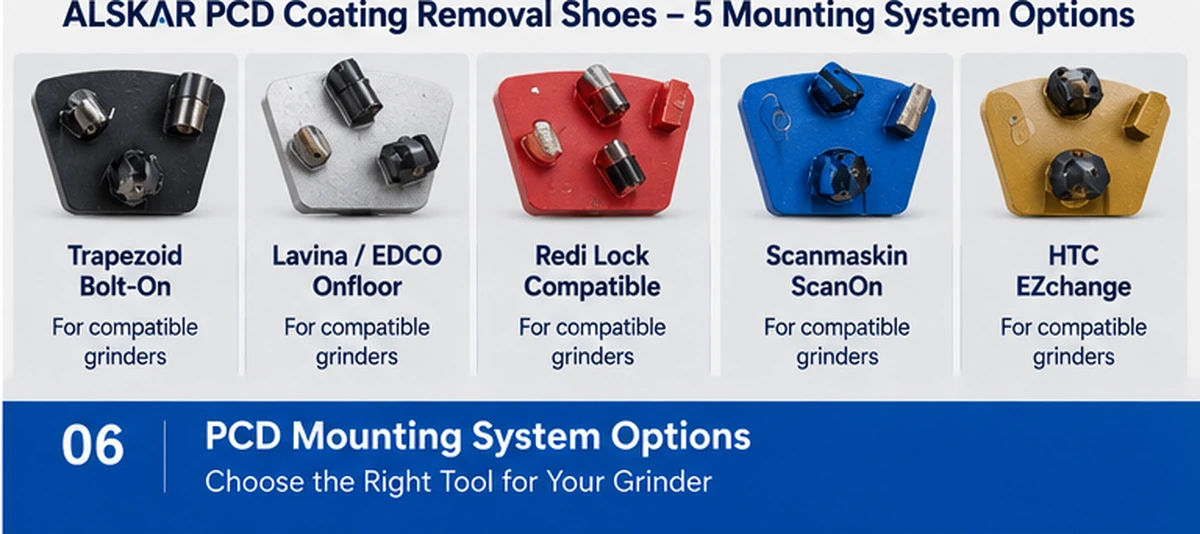
These are mounting-system options within the ALSKAR PCD Coating Removal Shoes product family.
Compatibility must be confirmed using the exact grinder model and mounting arrangement.
Compatibility terminology does not imply endorsement by or affiliation with the corresponding equipment manufacturers.
Do not select a shoe based only on its color, general shape, or appearance.
Also check tool orientation and any manufacturer-specified rotation requirements.
10. ALSKAR DIAMOND PCD Coating Removal Shoes
ALSKAR DIAMOND offers Supreme Quality PCD Coating Removal Shoes designed for compatible coating-removal applications.
The product family is organized by mounting system, helping buyers select tooling that fits their grinding equipment.
Product Highlights
- Supreme Quality product grade
- PCD cutting elements for compatible coating removal
- Multiple mounting configurations
- Options for professional floor preparation applications
- Flexible order quantities based on customer requirements
PCD cutter arrangements may differ among mounting-system variations.
Buyers should review the actual product photographs and specifications of the selected variation.
Do not assume that every mounting option has identical cutter geometry or removal characteristics.
PCD vs. Diamond Grinding: Which Should You Buy?
If the main objective is removing a compatible epoxy, paint or adhesive coating, PCD tooling may be the appropriate starting point.
If the objective is grinding concrete, preparing a specified surface profile or refining the substrate after coating removal, conventional diamond grinding shoes are generally more appropriate.
For multi-stage floor renovation, both tool categories may be needed.
Explore ALSKAR DIAMOND PCD Coating Removal Shoes to compare mounting options for Trapezoid Bolt-On, Lavina / EDCO / Onfloor, Redi Lock Compatible, Scanmaskin ScanOn Compatible, and HTC EZchange Compatible grinders.
For applications requiring concrete surface grinding after coating removal, explore our Diamond Grinding Shoes and choose the appropriate abrasive specification for your floor preparation requirements.
11. Dust Control and Jobsite Safety
Concrete grinding and floor preparation can generate hazardous airborne dust.
In the United States, OSHA’s construction silica standard, 29 CFR 1926.1153, includes specified exposure-control methods for relevant grinding and milling equipment.
For walk-behind floor grinders, Table 1 addresses integrated water-delivery systems and qualifying vacuum dust-collection systems.
Requirements differ by equipment type, task and operating conditions.
Always use the applicable exposure-control method and follow the equipment manufacturer’s instructions.
Additional Safety Considerations
Before grinding or removing coatings:
- Identify any potentially hazardous coating or adhesive materials.
- Verify tool and machine mounting compatibility.
- Inspect cutters, segments and mounting components.
- Follow machine speed and operating instructions.
- Use applicable dust-control systems.
- Follow appropriate electrical and wet-operation precautions.
- Manage slurry and waste appropriately.
- Keep unauthorized people out of the work area.
A connected vacuum does not automatically demonstrate regulatory compliance.
The complete equipment and exposure-control arrangement must satisfy the applicable requirements.
12. Final PCD vs. Diamond Grinding Shoe Selection Checklist
Before selecting tooling, confirm:
- Are you removing a coating or grinding concrete?
- What material is being removed?
- How thick and strongly bonded is the coating?
- Is the concrete substrate to be preserved?
- What surface profile is required?
- Which grinding machine will be used?
- What mounting system does the machine require?
- Is the cutter design suitable for the application?
- What dust-control and safety requirements apply?
- Will additional diamond grinding be necessary after coating removal?
Final Recommendation
PCD Coating Removal Shoes are typically selected for mechanical removal of compatible surface coatings.
Metal-bond Diamond Grinding Shoes are generally selected for grinding and preparing the concrete substrate.
For many professional floor preparation projects, the best solution is not PCD or diamond grinding alone—it is using the appropriate tool at each stage of the job.
Frequently Asked Questions
What is the difference between PCD and diamond grinding shoes?
PCD shoes use polycrystalline diamond cutters for compatible coating removal, while conventional metal-bond diamond grinding shoes primarily abrade and prepare concrete surfaces.
Are PCD shoes better for removing epoxy?
PCD tooling can be effective for many epoxy coatings. Selection depends on coating thickness, adhesion, formulation and substrate requirements.
Can diamond grinding shoes remove paint?
Some paints and thin coatings can be removed with diamond grinding tools. However, sticky coatings may clog conventional abrasive segments.
Can PCD tools grind concrete?
PCD tools can contact and remove some concrete during aggressive coating removal, but they are generally not selected for controlled concrete grinding or finishing.
Do PCD shoes damage concrete floors?
Aggressive PCD cutters can leave scratches or gouges. Always consider tool design and test a small area when surface preservation matters.
Should I use PCD before diamond grinding?
For many coating-removal projects, PCD is used first for bulk removal, followed by diamond grinding to refine and prepare the concrete substrate.
What is the best tool for removing floor glue?
It depends on adhesive properties. PCD tools are often used for compatible adhesive removal, but older unknown materials must be evaluated for potential hazards before disturbance.
Are Redi Lock and EZchange grinding shoes interchangeable?
No. They use different mounting systems. Verify the exact equipment model and approved mounting arrangement.
How do I select PCD shoes for a Lavina grinder?
Confirm the exact grinder model and mounting configuration before choosing the corresponding ALSKAR PCD variation.
Do I need dust extraction when removing coatings?
Applicable dust-control requirements depend on the coating, concrete substrate, equipment and work conditions. Silica-containing concrete grinding requires appropriate exposure controls.
Explore ALSKAR DIAMOND Floor Grinding Tools
ALSKAR DIAMOND provides PCD Coating Removal Shoes and diamond grinding tools for professional floor preparation applications.
Explore the appropriate product series based on your coating type, concrete condition, grinder model and mounting requirements.
For product selection assistance, contact ALSKAR DIAMOND with your grinder model, mounting system, material being removed and desired surface preparation result.
Technical note: This guide provides general tooling-selection information. Always follow the specific product documentation, grinder manufacturer instructions, coating system requirements and applicable workplace safety regulations.