Why Do Diamond Core Bits Stop Drilling? Common Causes and Solutions

Why Do Diamond Core Bits Stop Drilling? Common Causes and Solutions
A Professional Diamond Core Drilling Troubleshooting Guide for Concrete, Reinforced Concrete, Brick, and Masonry
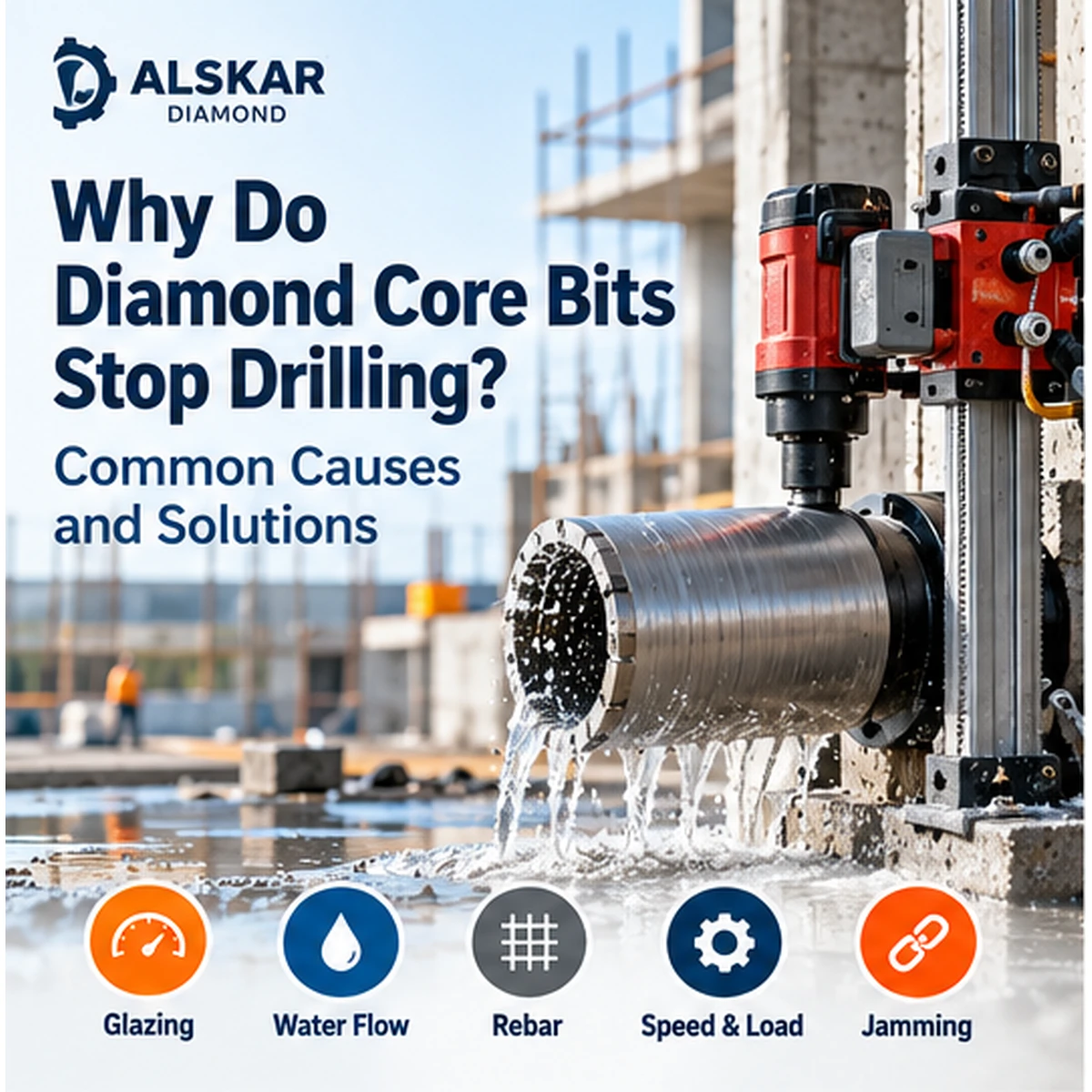
A diamond core bit that suddenly stops cutting can cause significant delays on a construction project.
Sometimes the drill motor continues to rotate normally, but the bit makes little progress. In other cases, the drilling speed decreases gradually, the machine overloads, or the core bit becomes stuck inside the hole.
These symptoms do not always mean the diamond core bit is defective.
Common causes include glazed diamond segments, an unsuitable bond specification, incorrect drilling speed, insufficient water flow, excessive or inadequate feed pressure, reinforcement, blocked slurry removal, and drill rig problems.
Understanding the symptoms can help contractors identify the actual cause before replacing a bit unnecessarily.
In this guide, ALSKAR DIAMOND explains why diamond core bits stop drilling, how to troubleshoot common problems, and when to select a different core bit.
1. First Identify the Drilling Problem
Before making adjustments, identify exactly how the drilling performance has changed.
A bit that rotates without penetrating concrete requires a different inspection process from a bit that is physically jammed.
Diamond Core Bit Troubleshooting Chart
| Symptom | Possible Cause | Recommended Action |
|---|---|---|
| Bit rotates but barely cuts | Glazed or polished diamond segments | Inspect segments; use approved dressing procedure |
| Drilling gradually becomes slower | Wrong bond, segment wear, incorrect speed | Check material compatibility and drill settings |
| Drilling slows sharply at one depth | Rebar or other obstruction | Stop and verify the obstruction; use an approved bit and procedure |
| Little slurry or cutting debris exits | Blocked or insufficient water delivery | Inspect water supply and flushing |
| Motor overloads or clutch slips | Excessive loading, incorrect gear, obstruction | Reduce loading; inspect machine and cutting conditions |
| Bit becomes stuck | Jammed core, debris, reinforcement or rig movement | Stop and isolate equipment before recovery |
| Excessive vibration | Unstable rig, damaged bit or loose connection | Stop drilling and inspect the complete setup |
| Diamond segment breaks or detaches | Impact, overheating, fatigue or damaged tooling | Stop immediately; replace or professionally evaluate the bit |
| Bit cannot reach required depth | Barrel or effective-depth limitation | Check drilling depth and approved extensions |
| Dry masonry drilling produces poor results | Wrong material, overheating or blocked debris removal | Verify the dry core bit’s approved application |
Important: This chart is a starting point, not a substitute for the drilling equipment manufacturer’s troubleshooting procedures.
If a bit becomes jammed, damaged, or unstable, stop work before conducting an inspection.
2. Cause #1: Glazed Diamond Core Bit Segments
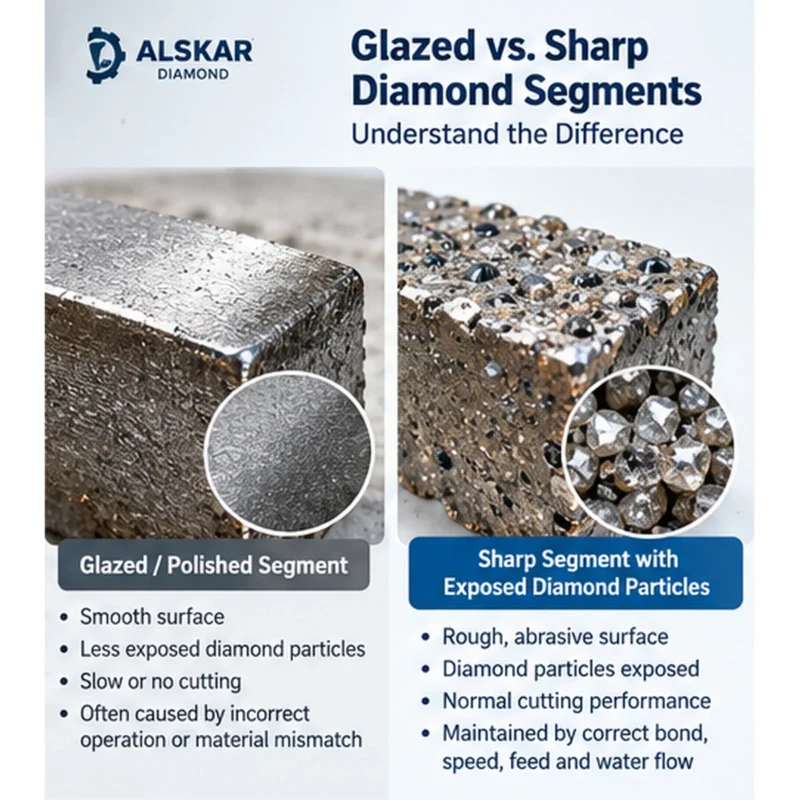
One of the most common reasons a diamond core bit stops cutting is segment glazing.
Diamond core bits cut through a combination of exposed industrial diamond particles and a supporting bond matrix.
As the bit cuts concrete, controlled bond wear helps expose fresh diamond cutting points.
Under some conditions, the diamond cutting face becomes polished or glazed instead of remaining sufficiently abrasive.
Signs of a Glazed Core Bit
Common symptoms include:
- The drill motor continues rotating.
- Penetration becomes unusually slow.
- The segments look relatively smooth or polished.
- The cutting face produces little effective material removal.
- Increasing feed pressure does not restore normal performance.
Glazing can occur in hard, low-abrasion materials or when the bit and operating conditions are not appropriately matched.
Insufficient cutting load or extended rotation without effective cutting may also contribute.
How to Restore a Glazed Core Bit
First, stop the drill and inspect the segments.
If the segments remain structurally sound, an approved dressing or sharpening plate may help restore cutting performance.
Follow the core bit and drill manufacturers’ procedures for dressing.
For wet-only core bits, maintain the approved wet-operation requirements. Do not attempt to sharpen them by dry drilling or overheating the segments.
If repeated glazing occurs, the problem may be the selected diamond bond rather than a temporary operating condition.
Professional tip: Repeatedly increasing pressure on a glazed core bit can overload the motor without correcting the underlying cutting problem.
3. Cause #2: Wrong Diamond Bond for the Concrete
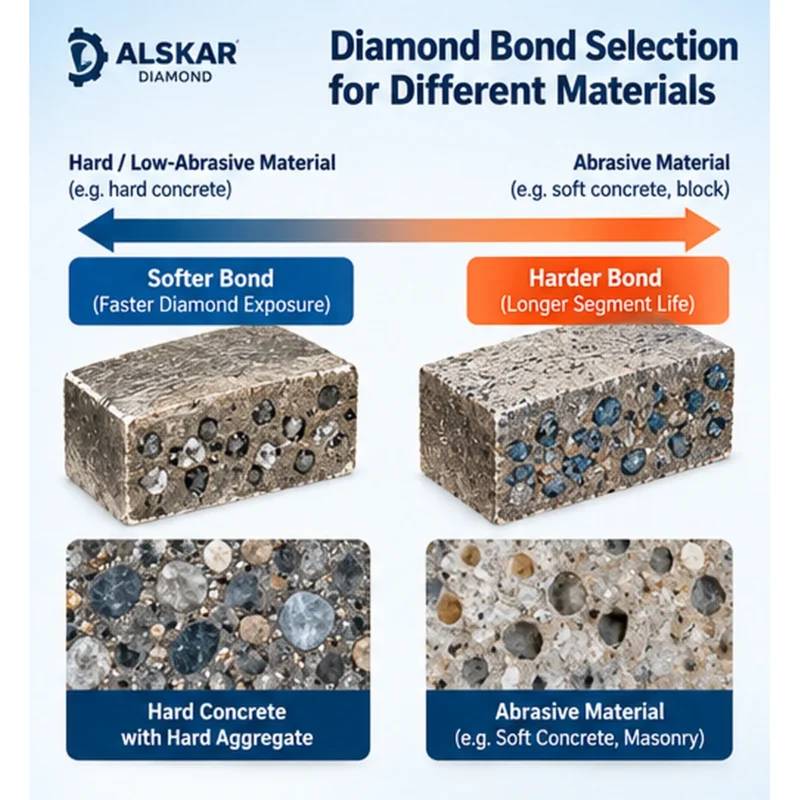
Concrete varies significantly in cutting characteristics.
Two slabs with similar compressive strength can behave differently because of their aggregate composition, abrasiveness, age, and reinforcement.
Hard Aggregate and Diamond Bond Selection
In hard, relatively nonabrasive concrete, the bond may fail to release worn diamond particles quickly enough.
A more appropriate, relatively softer bond may be needed to promote exposure of fresh diamond cutting points.
In highly abrasive material, a more wear-resistant bond may help control excessive segment consumption.
However, the words “hard bond” and “soft bond” are relative to a particular manufacturer’s product range.
There is no universal bond designation that guarantees the same performance across all brands.
Signs That the Bond May Be Wrong
- Persistent glazing despite correct operation
- Unusually slow cutting in specific concrete
- Rapid segment consumption
- Excessive heat or cutting resistance
- Significant performance differences between jobsites
Recommended Solution
Identify the aggregate and material characteristics, review the actual bit specification, and select a bond designed for the drilling application.
Do not choose a different bond solely because a previous core bit worked well on another project.
How to Choose the Right Diamond Core Bit
4. Cause #3: Insufficient or Incorrect Water Flow

Water is essential to the operation of wet diamond core bits.
It helps cool the cutting segments, flush slurry out of the hole, and reduce airborne dust.
What Happens When Water Flow Is Too Low?
Insufficient water delivery may cause:
- Excessive heat
- Reduced cutting performance
- Slurry accumulation
- Accelerated segment wear
- Increased risk of binding
- Potential damage to components
Before wet drilling, verify that water reaches the cutting area through the intended delivery path.
Inspect hoses, fittings, filters, water connections, and any flow-control components.
Can Too Much Water Also Reduce Cutting Performance?
In some drilling systems, excessive water flow may reduce cutting efficiency or indicate incorrect setup.
However, the solution is not to operate a wet-only bit without adequate water.
Adjust flow according to the equipment manufacturer’s instructions while maintaining the water delivery required for cooling, slurry removal, and dust control.
Slurry Is a Useful Indicator
During wet core drilling, slurry should be removed effectively rather than accumulating inside the cut.
A blocked water path or poorly flushing hole can increase friction and reduce productivity.
If slurry is not clearing, stop and inspect the water system and drilling conditions.
Wet vs. Dry Diamond Core Drilling
5. Cause #4: Incorrect Drilling Speed or Feed Pressure
Diamond core bits require an appropriate relationship between rotational speed and feed pressure.
The correct operating speed depends on core bit diameter, drill motor capability, material, and the manufacturer’s instructions.
Incorrect RPM
Running at an unsuitable speed can reduce drilling efficiency and increase wear.
Large-diameter core bits generally require different operating conditions from small-diameter bits.
Do not apply a single universal RPM setting to all diamond core bits.
Feed Pressure Too Low
Insufficient feed can allow the bit to rotate without engaging the material effectively.
This may contribute to polishing and poor penetration.
Feed Pressure Too High
Excessive feed can overload the motor, cause the safety clutch to slip, or increase the risk of bit damage.
More pressure does not always mean faster drilling.
Recommended Operating Practice
- Verify the drilling machine’s approved speed range.
- Match the gear to the core bit diameter and material.
- Secure and align the drill rig.
- Start with controlled pressure.
- Monitor cutting behavior and motor load.
- Adjust only within manufacturer-approved operating limits.
A stable, controlled drilling process is more important than applying maximum force.
6. Cause #5: Reinforcement or Steel Obstructions

When a core bit reaches reinforcing steel, the cutting resistance may change significantly.
The drilling rate may fall, and the motor load may increase.
However, not every diamond core bit is approved for drilling through rebar.
How to Recognize Possible Rebar Contact
Possible indicators include:
- A sudden decrease in penetration
- A noticeable change in drilling sound or resistance
- Increased motor loading
- Metallic particles appearing in the slurry
These observations are not definitive proof of rebar. Always verify the conditions.
What Should You Do?
If reinforcement is suspected:
- Stop and confirm that the location is approved for coring.
- Review structural plans and applicable site procedures.
- Verify that the selected bit is rated for reinforced concrete.
- Follow the drill manufacturer’s rebar-drilling instructions.
- Maintain the specified water delivery and operating conditions.
Do not force an unsuitable bit through steel.
ALSKAR Laser-Welded Wet Core Bits
For applications involving approved reinforced concrete drilling, ALSKAR offers a dedicated Laser-Welded Wet Core Bit series.
This series is designed for wet concrete core drilling, including rebar applications within the product’s intended operating conditions.
The bit still must be matched to the drilling machine, connection, diameter, and project requirements.
Important: Permission to drill through reinforcement is a structural and jobsite decision, not merely a cutting-tool selection.
7. Cause #6: The Core Bit Is Jammed
A jammed bit is different from a glazed bit.
In a jammed condition, the bit may be unable to rotate or move freely.
Possible causes include:
- A concrete core trapped inside the barrel
- Loose material wedged between the core and the barrel
- Reinforcement or other obstructions
- Poor drilling alignment
- Movement of the drill stand
- An excessively worn or damaged barrel
- An unsuitable or damaged toolholder connection
What to Do When a Core Bit Becomes Stuck
Stop drilling immediately.
Switch off the machine and isolate its power source before investigating, in accordance with the manufacturer’s instructions.
Do not attempt to free a bit by running the motor aggressively or forcing the feed mechanism.
Follow the specific drill manufacturer’s jam-release and core-removal procedure.
Improper reverse rotation or excessive force can loosen connections or damage the equipment.
If the bit cannot be released safely, seek qualified service assistance.
Preventing Core Bit Jamming
- Use a securely mounted drill rig.
- Maintain proper alignment.
- Ensure effective slurry removal.
- Inspect the barrel and connections.
- Remove cores according to the approved procedure.
- Do not exceed the bit’s effective drilling depth.
8. Cause #7: Worn, Broken, or Detached Diamond Segments
Not every non-cutting core bit can be restored through dressing.
A core bit may have reached the end of its service life or sustained mechanical damage.
Normal Segment Wear
Gradual segment consumption is expected during cutting.
However, once the segment reaches the manufacturer’s replacement limit, continued use may damage the barrel or produce unsafe operation.
Broken or Missing Segments
A missing or damaged segment can cause vibration, uneven cutting, or additional damage.
Stop drilling immediately if a segment fractures or separates from the barrel.
Do not continue drilling with a visibly damaged cutting rim.
Barrel Damage
A bent or distorted barrel may bind in the hole or cause uneven segment contact.
Inspect the complete tool, not only the diamond cutting edge.
When to Replace the Core Bit
Replace the bit or obtain a qualified assessment when:
- Segments are missing or fractured.
- The barrel is visibly deformed.
- The connection is damaged.
- Segment wear exceeds the manufacturer’s permitted limit.
- Approved dressing does not restore cutting performance.
- The bit is not suitable for the actual material.
9. Cause #8: Drill Rig, Motor, or Connection Problems
Sometimes the core bit is not the primary problem.
A worn chuck, damaged spindle, unstable drill stand, or incorrect motor setting can produce symptoms resembling a defective bit.
Common Mechanical Problems
- Loose or contaminated connections
- Incorrect spindle thread or adapter
- Unstable drill stand
- Worn bearings or excessive play
- Slipping safety clutch
- Motor overload
- Incorrect gear selection
- Damaged feed mechanism
Why Thread Compatibility Matters
The bit connection must match the drill spindle or an approved adapter.
For example, some ALSKAR wet core bit sizes use 5/8″-11, while larger sizes use 1-1/4″-7 connections.
The required connection depends on the specific product and diameter.
A matching nominal thread is not sufficient if the adapter, shoulder, spindle, or complete mounting arrangement is unsuitable.
Never operate a core bit with a loose or damaged connection.
10. Choosing the Correct ALSKAR Diamond Core Bit
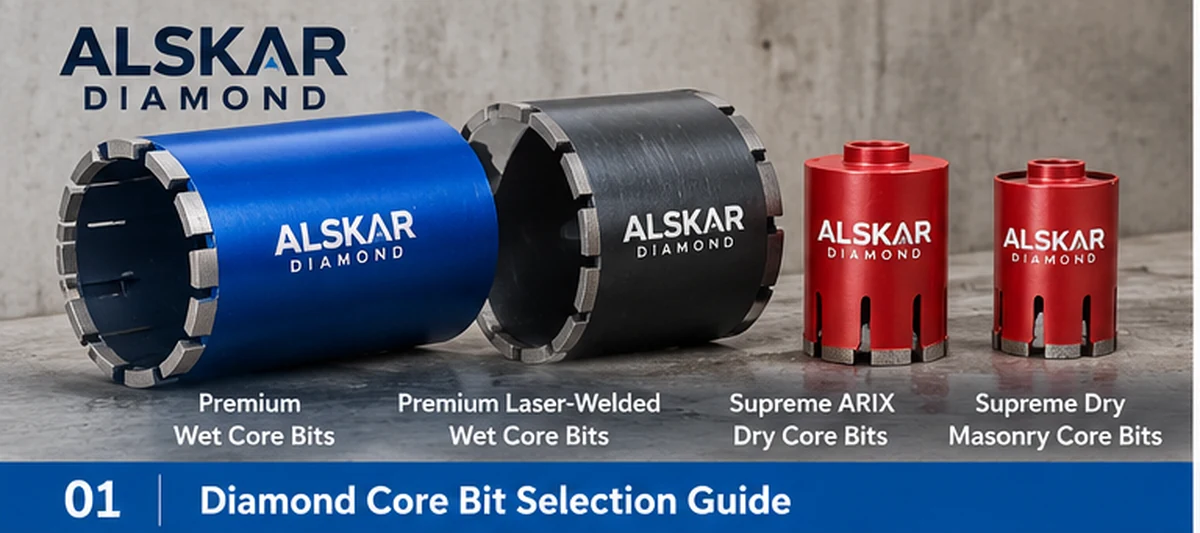
ALSKAR DIAMOND provides separate core bit families for different drilling applications.
Selecting the correct product before drilling is one of the most effective ways to avoid preventable problems.
ALSKAR Diamond Core Bit Selection Guide
| Product Series | Confirmed Specifications | Recommended Application |
|---|---|---|
| Premium Wet Core Bits | 1″–14″ diameter; 18″ barrel; 14″ effective depth; 10 mm segments; silver-brazed | Compatible wet concrete core drilling |
| Premium Laser-Welded Wet Core Bits | 1″–16″ diameter; 16″ overall length; 14″ effective depth; 10 mm segments | Wet concrete drilling, including approved rebar applications |
| Supreme ARIX Dry Core Bits | 2″–6″ diameter; 9″ barrel; 5/8″-11 connection | Soft brick, CMU, and compatible soft masonry |
| Supreme Dry Masonry Core Bits | 1″–6″ diameter; 9″ barrel; 9″ effective drilling depth; 5/8″-11 connection | Soft brick, CMU, and soft masonry |

Important Selection Rules
Wet core bits: Operate with the required water supply. Do not use wet-only bits dry.
Laser-welded wet core bits: Select for the series’ specified applications, including approved reinforced concrete work.
Dry masonry core bits: Use only on suitable soft brick, concrete masonry units, and soft masonry within the product’s ratings. These ALSKAR dry masonry series are not intended for drilling solid concrete or reinforced concrete.
Connection: Verify the thread, adapter, bit diameter, and drill motor compatibility before installation.
Depth: Check effective drilling depth separately from overall tube or barrel length.
The words “laser-welded” or “ARIX” alone do not establish universal material compatibility.
11. How to Prevent Diamond Core Drilling Problems
Preventive inspection can reduce unnecessary downtime and tool damage.
Before Drilling
- Confirm the concrete or masonry material.
- Identify possible reinforcement, utilities, and embedded hazards.
- Verify the exact core bit series and application.
- Check diameter, thread, and drilling depth.
- Inspect segments and the barrel.
- Secure the drilling rig.
- Verify drilling speed and feed settings.
- Check water delivery or approved dust extraction.
During Drilling
- Monitor the drilling rate.
- Observe motor loading.
- Maintain stable feed pressure.
- Watch for abnormal vibration.
- Verify effective slurry or debris removal.
- Stop when cutting behavior changes unexpectedly.
After Drilling
- Inspect segment condition.
- Remove accumulated slurry and debris.
- Check the barrel and connection.
- Store the core bit appropriately.
- Record unusual wear patterns for future tool selection.
If the same problem occurs repeatedly, evaluate the complete drilling system rather than simply replacing the same core bit again.
12. Concrete Core Drilling Safety and Silica Dust Control
Core drilling concrete or masonry can generate respirable crystalline silica.
In the United States, OSHA’s construction silica standard, 29 CFR 1926.1153, identifies specified exposure-control methods for certain drilling operations.
For rig-mounted core saws or drills, Table 1 specifies integrated water delivery to the cutting surface and proper equipment operation and maintenance.
A dry-rated core bit does not automatically exempt a contractor from silica exposure-control requirements.
Where Table 1 does not apply, or its specified method is not fully implemented, the applicable alternative exposure-control requirements must be followed.
Additional Safety Precautions
Before starting work:
- Check for electrical, plumbing, utility, and structural hazards.
- Obtain the required authorization before cutting reinforcement.
- Secure the drill stand correctly.
- Protect people below wall, slab, or overhead drilling locations.
- Use appropriate water and electrical safety measures.
- Control and collect drilling slurry.
- Follow equipment-specific maintenance procedures.
- Stop using damaged or unstable tooling.
Collected slurry must be managed appropriately. Do not allow dried slurry to become an uncontrolled dust source.
13. Final Diamond Core Bit Troubleshooting Checklist
When a diamond core bit stops drilling, inspect the problem systematically.
- Check the cutting surface. Are the diamond segments polished, worn, or damaged?
- Confirm the material. Is the selected bit suitable for the concrete, aggregate, reinforcement, or masonry?
- Inspect water or debris control. Is the cut being cooled and cleared correctly?
- Check drill speed. Is the motor operating in the appropriate gear?
- Review feed pressure. Is the cutting load suitable?
- Consider obstructions. Has the bit reached steel or become mechanically jammed?
- Inspect the drill rig. Are the stand, spindle, chuck, and connections stable?
- Verify depth. Has the bit reached its effective drilling limit?
- Evaluate segment condition. Can it be restored safely, or should it be replaced?
- Choose the correct replacement. Match the new bit to the actual material and machine.
Final Recommendation
A diamond core bit that stops cutting is not necessarily defective.
In many cases, performance problems can be traced to segment glazing, material mismatch, improper water delivery, drilling speed, feed pressure, or equipment conditions.
The most effective troubleshooting process begins with a careful inspection and ends with selecting the correct drilling system.
For professional concrete and masonry drilling, application-matched diamond core bits, correct machine settings, and safe operating practices are essential for consistent performance.
Frequently Asked Questions
Why does my diamond core bit spin but not drill?
Possible causes include glazed diamond segments, an unsuitable bond, incorrect speed, inadequate feed pressure, or poor water delivery. Inspect the complete drilling setup before replacing the bit.
What is diamond core bit glazing?
Glazing occurs when the segment cutting face becomes polished and no longer exposes effective diamond cutting points. Penetration can become very slow even while the motor continues rotating.
How do I sharpen a glazed diamond core bit?
If the bit is structurally sound, use the dressing method approved by the manufacturer, such as a suitable sharpening plate. Do not operate wet-only core bits dry to sharpen them.
Why is my core bit drilling slowly in hard concrete?
Hard aggregate, incorrect bond selection, glazed segments, unsuitable RPM, or improper drilling conditions can reduce cutting efficiency.
Can too much water slow diamond core drilling?
Excessive water flow can reduce cutting efficiency in some systems. Follow the drilling equipment manufacturer’s settings while maintaining adequate cooling, flushing, and dust control.
Can diamond core bits cut through rebar?
Only use bits specifically approved for reinforced concrete. Confirm structural authorization, machine compatibility, and approved operating procedures. ALSKAR offers laser-welded wet core bits for suitable rebar applications.
What should I do if my diamond core bit gets stuck?
Stop and isolate the drilling equipment. Follow the manufacturer’s jam-release procedure. Do not force the motor or attempt uncontrolled reverse rotation.
Why are my diamond core bit segments breaking?
Possible causes include impact, vibration, poor alignment, overheating, unsuitable applications, or mechanical damage. Stop immediately when segments are fractured or missing.
Can I use a dry masonry core bit on reinforced concrete?
No. ALSKAR dry masonry core bit series are designed for compatible soft brick, CMU, and soft masonry, not solid or reinforced concrete.
How do I choose between wet and dry diamond core bits?
Match the bit to the material, machine, drilling method, depth, and connection. Use the appropriate wet concrete bit for approved concrete drilling and dry masonry bits only for rated soft masonry applications.
Explore ALSKAR DIAMOND Diamond Core Bits
ALSKAR DIAMOND offers diamond core bit solutions for professional concrete and masonry drilling applications.
Explore our Premium Wet Core Bits, Laser-Welded Wet Core Bits, and Supreme Dry Masonry Core Bits to find the appropriate tool for your material and equipment.
For technical selection assistance, provide the drilling material, core diameter, required depth, reinforcement conditions, drill motor, connection thread, and desired drilling method.
Technical note: This guide provides general troubleshooting information. Always follow the specific core bit and drilling equipment manufacturers’ instructions, approved jobsite procedures, and applicable safety regulations.